A one-to-one campaign delivers a message tailored to the individual recipient — the right offer, tone, and call to action for that person and moment — instead of one message sent to everyone. For a regulated brand, the hard part was never deciding that 1:1 is better. It's that hitting "one to one" means generating thousands of message variants, and in banking, insurance, and telco every variant is a regulated asset that legal has to stand behind. Generic content-personalization tools multiply the variants and multiply the compliance exposure with them. That is the trade-off this guide dissolves.
This is written for the person who owns the lifecycle engine — the Head of CRM, Head of Lifecycle, or SFMC / Adobe Campaign lead responsible for onboarding, activation, cross-sell, and retention across email, app, and push. It covers what a one-to-one campaign actually is, how it differs from a segmented one, how you run one at scale, and how to do it without sending every variant back through a multi-week compliance reset.
What is a one-to-one campaign?
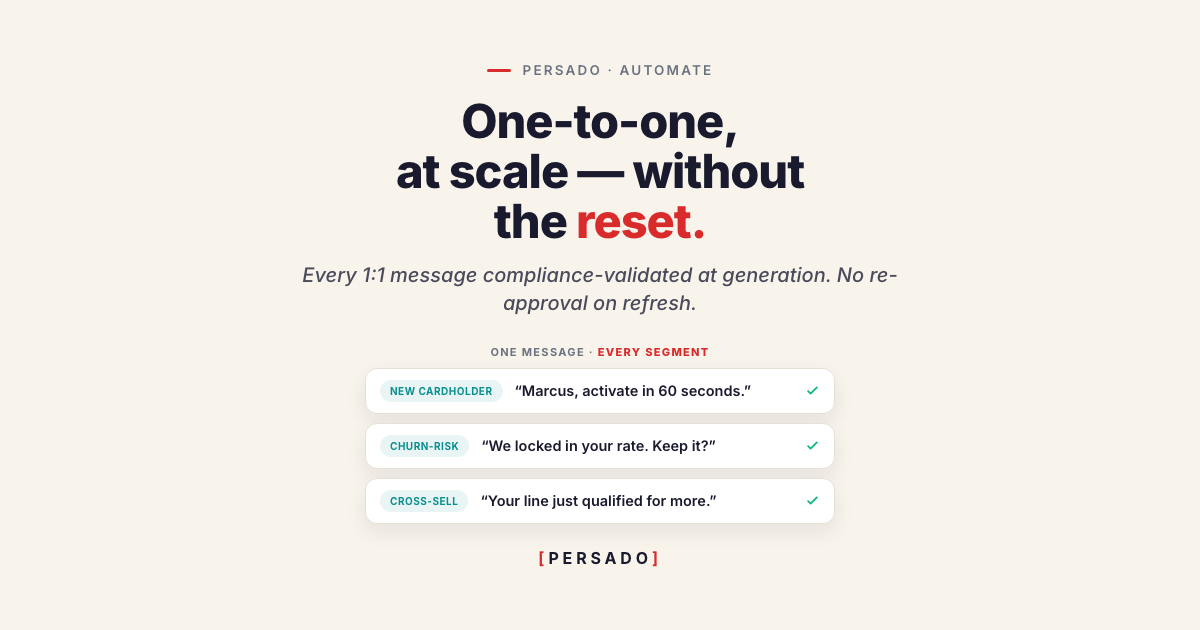
A one-to-one campaign — also written 1:1 — is a lifecycle program where the message adapts to the individual rather than to a broad audience. The subject line, the emotional framing, the offer emphasis, and the CTA are chosen for the recipient's segment, behavior, and stage in the lifecycle. The goal is relevance at the level of the individual: a churning cardholder, a newly activated checking customer, and a cross-sell prospect each receive a message engineered for them, not the same template with a first-name merge tag.
The distinction that matters operationally is between the container and the content. Delivery tools have handled the container — dynamic modules, real-time creative assembly, send-time optimization — for years. What stays manual is the content: the actual regulated language inside each variant. That is where volume becomes a compliance problem, and it's where this guide focuses.
One-to-one vs. segmented campaigns
Segmented and one-to-one campaigns sit on the same spectrum — how finely you divide the audience — but they break in different places at scale.
- Unit of targeting — Audience buckets (e.g. "lapsed", "high-value") · The individual / micro-segment
- Number of message variants — A handful per campaign · Thousands, refreshed continuously
- Relevance ceiling — Bounded by how coarse the buckets are · Individual-level relevance
- Where it breaks for regulated brands — Coverage — the buckets are too broad to lift performance much further · Compliance throughput — every variant is a regulated asset that needs review
- What the delivery tool solves — Which bucket gets which pre-built creative · The container, not the compliant language inside it
- What's still manual — Writing and approving each bucket's copy · Writing and approving each variant's copy — at 100× the volume
Read the last two rows and the real constraint is clear. Moving from segmented to one-to-one doesn't just multiply creative work — it multiplies the compliance review load, because in a regulated industry every variant is an asset legal is accountable for. The reason most lifecycle programs stall at coarse segmentation isn't ambition. It's that the compliance queue can't absorb 1:1 volume.
How do you personalize marketing at scale?
Running true 1:1 across a lifecycle program at volume takes three things working together — and the third is the one point tools skip:
- Generation — produce segment-specific variants programmatically instead of hand-writing each one. This is the part generic AI has made cheap.
- Governance — hold every variant to the brand's voice and the regulator's rules. In banking, insurance, telco, and gaming, this is non-negotiable and it's where volume creates risk.
- Performance signal — know which variant will actually move the outcome before you send it, so scale means more wins, not just more sends.
Most stacks nail step 1, bolt step 2 on afterward as a manual review, and treat step 3 as an after-the-fact A/B test. That sequence is exactly what caps a lifecycle program at segment level: the faster you generate, the longer the compliance queue, and you're still guessing at performance. "Content personalization at scale" only works when generation, compliance, and performance happen in one motion — not three disconnected stages.
Personalization at scale without a compliance reset
Here is the wedge for a regulated brand. A generic 1:1 tool makes the volume problem worse: it generates more variants and hands all of them to a review function that was already the bottleneck, with no compliance built in and no performance signal attached. More output, more risk, more queue.
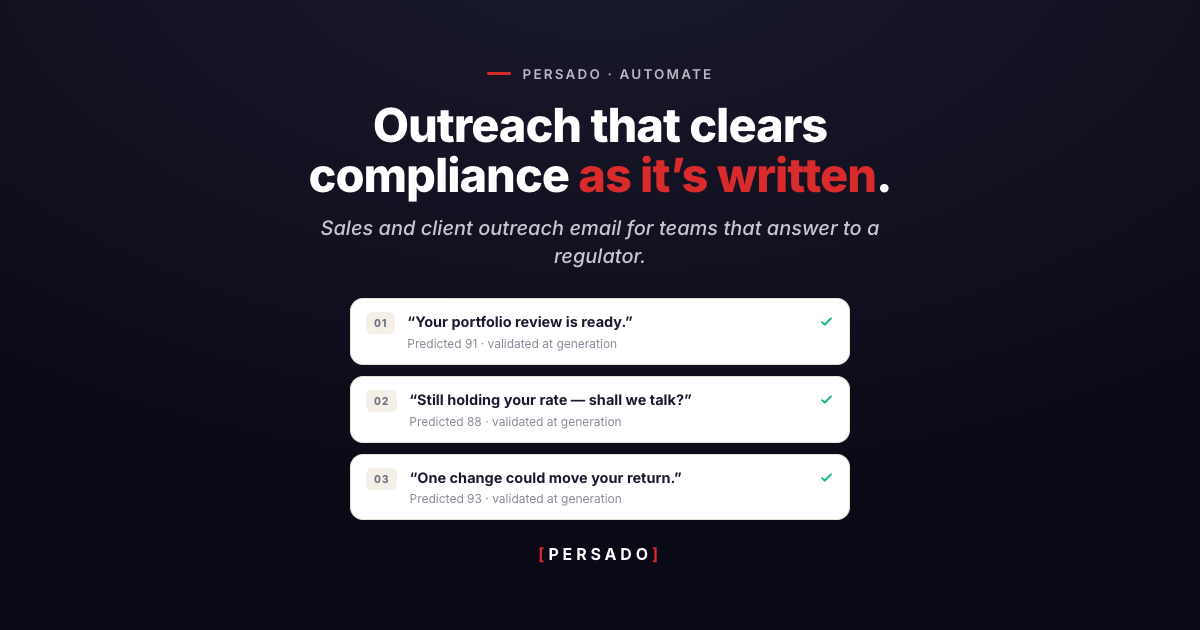
Persado's AUTOMATE play inverts the sequence. Instead of generate → then review → then guess, the motion is:
Generate → compliance-validate → performance-score — on every variant, in one pass, before anything ships.
Each variant is checked during generation against 20+ regulatory frameworks, not scanned reactively after a draft exists. Compliance isn't a gate the variant hits later — it's a property the variant is generated with. That is what makes 1:1 volume survivable in a regulated environment, and it lands in the order that matters for this buyer:
- Speed. Optimize every lifecycle message by segment in real time — no manual refresh cycles, no template sprawl. Production-ready assets arrive in days, not weeks (4× faster, with a 72-hour average brief-to-market deployment), and refresh happens in-channel instead of in a quarterly rebuild.
- Cost. The AUTOMATE motion replaces manual content-refresh labor — the recurring cost of a team rewriting and re-approving templates — at 75% lower cost. It displaces spend the lifecycle program already carries rather than adding a new line item.
- Compliance. Every variant is validated during generation against 20+ regulatory frameworks, producing 90% fewer compliance rejections and zero compliance incidents. Scaling from a handful of segments to true 1:1 no longer means scaling the review queue with it.
- Performance. Each variant carries a Performance Prediction Score before it sends, so scale produces more wins, not just more volume — and the score isn't a black box; it's an explainable, model-generated ranking built on 1T+ messages analyzed across 120K+ campaigns. The result is a 96% win rate against human-written and generic-LLM content, measured across 120K+ campaigns, and $2.5B+ in incremental value — vs. control, across all comms, over four years.
That ordering is deliberate: speed is the universal pain, cost compounds it, compliance removes the "won't this break at scale?" objection, and performance is the closer earned only once the first three are true.
It plugs into the stack you already run
None of this asks the CRM team to adopt another silo. The content generated this way embeds in the lifecycle stack you operate today — SFMC, Adobe Campaign, and Movable Ink — as the compliant, performance-scored language layer inside your existing delivery and orchestration. Your delivery tool keeps handling the container and the send; Persado supplies the regulated content that fills every variant, validated on the way in. It's a governed agent workflow that produces straight-through output, not a new destination for your team to log into.
Where to start
If your lifecycle program is stuck at coarse segmentation because the compliance queue can't absorb 1:1 volume, the fastest proof is a single high-volume program — an onboarding, cross-sell, or retention flow — run through the generate → compliance-validate → performance-score motion.
See one-to-one at scale, compliance-validated on every variant. Book a 30-minute walkthrough → — bring one high-volume lifecycle program, and we'll show you segment-specific variants generated, compliance-validated, and performance-scored before a single send.
FAQ
What is a one-to-one campaign? A one-to-one (1:1) campaign is a lifecycle program where the message adapts to the individual recipient — subject line, framing, offer, and CTA chosen for that person's segment, behavior, and lifecycle stage — rather than one message sent to the whole list. It's the opposite of a single template with a merge tag: the content itself changes, not just the greeting.
How do you personalize marketing at scale? By making generation, compliance, and performance one motion instead of three stages. You generate segment-specific variants programmatically, validate each variant's compliance during generation (not in an after-the-fact review), and attach a performance prediction to each one before it sends. Personalizing at scale fails whenever generation runs ahead of a manual compliance queue — the faster you generate, the longer the queue.
Can AI personalize compliant marketing messages? Yes — if compliance is validated during generation rather than bolted on after. Generic AI writes the words and disclaims regulated use in its terms, so every variant still needs full manual review. Persado validates each variant against 20+ regulatory frameworks as it's generated, which is what delivers 90% fewer compliance rejections and zero compliance incidents at 1:1 volume.
One-to-one vs. segmented campaigns — what's the difference? A segmented campaign divides the audience into buckets and sends each bucket a pre-built message; a one-to-one campaign tailors the message to the individual or micro-segment. Segmentation is limited by how coarse the buckets are; one-to-one is limited, for regulated brands, by compliance throughput — every variant is a regulated asset that needs review. That review load is the reason most programs stall at segmentation, and it's what compliance-during-generation removes.
![[PRODUCT UPDATE] Three new ways to use Persado](https://a.storyblok.com/f/291846000560732/ec5ff57a41/q3-rundown-cover-v2.png)