[ THE IMPOSSIBLE TRADEOFF ]
There is a meeting that happens at regulated financial brands every quarter, sometimes every Tuesday. Marketing wants to move. Legal wants to review. Compliance wants a paper trail. And somewhere between those three rooms, a campaign that could have shipped in a week ships in ten — if it ships at all.
The marketing compliance review process has been treated as physics: speed adds risk; caution adds time. Marketing teams inside banks, insurance carriers, and regulated fintechs have absorbed this as a cost of doing business in a regulated world. They built longer timelines, hired more reviewers, and trained their creative teams to pre-negotiate what compliance would probably say.
The draft was never the hard part. The hard part was everything that came after it.
That trade-off was never physics. It was an architecture problem. The compliance step was placed after the creation step, which meant every piece of content had to travel a serial queue — create, then review, then revise, then re-review — before anything could move. Change the architecture, and you change the math.
[ PERSADO ] places compliance, performance prediction, and brand validation inside the generation step itself. Not downstream from it. The result is content that arrives production-ready, without a four-to-eight-week review queue standing between your brief and your customer.
Here are five mechanisms that make that possible.
[ 01 — COMPLIANCE AT THE POINT OF CREATION ]
The standard marketing compliance review process works like this: a writer drafts, a marketer approves, legal reviews, compliance reviews, sometimes a second legal partner reviews, and the campaign launches weeks or months after the brief was written. At every handoff, there is a new queue. At every queue, there is a new reason to send it back.
The root cause is not that compliance teams are slow. It is that compliance was never part of the generation step. It was always a filter applied after the fact — which means every piece of content was born non-compliant and had to be made compliant through iteration.
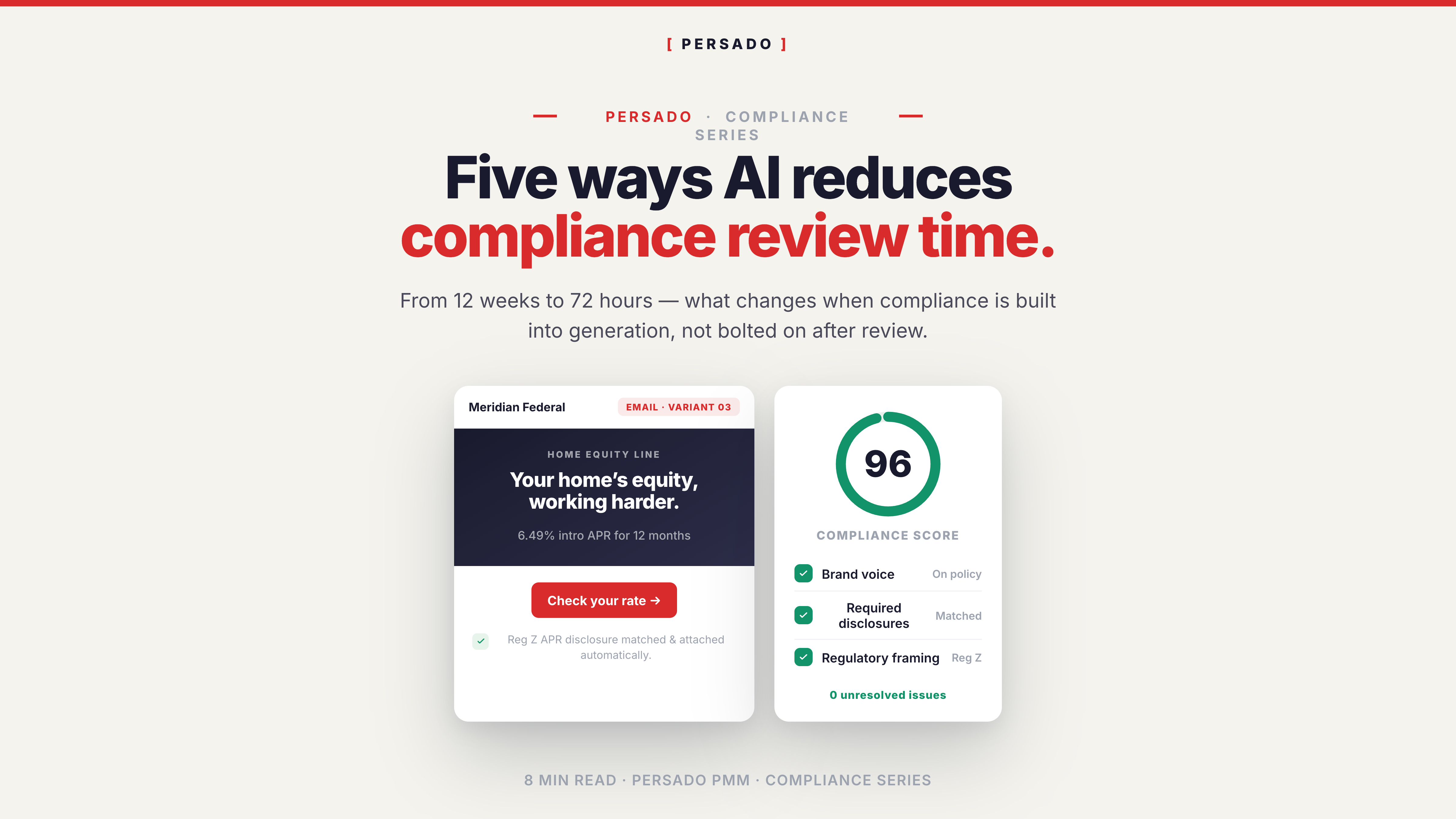
[ PERSADO ] inverts this. The Compliance Agent validates every word, phrase, and claim against 20+ regulatory frameworks at the moment of generation — not in a review layer that follows it. FCA guidelines, CFPB requirements, FINRA standards: these are not reference documents consulted after the draft exists. They are parameters that shape the draft as it is written. Content arrives compliant because compliance is a constraint on generation, not a checkpoint after it.
The result: rejection rates drop 90% compared to drafts produced by generic AI tools. That figure is not a quality-of-writing claim. It is a structural claim about where in the workflow the compliance check lives. When validation is a runtime operation rather than a post-production audit, the 4-to-8-week legal review queue compresses to a check that resolves before the content leaves the system. This is what it looks like to actually reduce compliance review time — not by adding more reviewers, but by relocating the review to a step where it can run instantly.
For your compliance team, this means fewer briefs landing in the inbox half-formed. For your marketing team, this means no re-approval needed when creative is refreshed within approved parameters. The audit trail is built at generation time — provenance, regulatory framework match, and parameter set recorded automatically, not reconstructed from email chains after the fact.
Production-ready is not a marketing claim. It is a statement about what the system delivers.
[ 02 — MULTI-JURISDICTION AS A RUNTIME PARAMETER, NOT A MANUAL AUDIT ]
If your brand operates across more than one regulatory jurisdiction — and most financial-services brands at scale do — you already know what the multi-market campaign cycle looks like. A piece of content approved for the US market goes into a separate review process for the UK. A campaign cleared under CFPB guidance requires a parallel track under FCA rules. The AMF has different requirements than BaFin. What passes CONSOB may not pass CNMV. And the EU AI Act has added a new layer that sits orthogonal to all of them.
The typical response to this complexity is additional headcount: more regional compliance reviewers, more market-by-market legal partners, more coordination overhead just to maintain what already exists. That is not a scaling strategy. That is a moat of cost around every campaign you want to run internationally.
[ PERSADO ] treats multi-jurisdiction compliance as a runtime configuration, not a manual audit process. The 20+ regulatory frameworks embedded in the Compliance Agent — covering FCA, CFPB, FINRA, SEC, OCC, AMF, BaFin, CONSOB, CNMV, GDPR, EU AI Act, Solvency II, and others — are switched on for each market as parameters, not researched campaign by campaign. When you brief for a UK retail bank audience, the FCA framework is active. When you brief for a US card audience, CFPB and FINRA govern the output. Both can run in parallel, both arrive compliant, and neither requires the other to block it.
A leading European cooperative bank running multi-market lifecycle campaigns found that this architecture eliminated the sequential country-by-country review cycle entirely for in-scope campaign types. The mechanism: compliance parameters are set at brief intake, not discovered during review. Content that ships for one market does not need to be re-examined from scratch for another — the framework governing each output is encoded in the generation log.
This is not generic AI with a compliance checklist appended. It is compliance built into the ontology of generation.
[ 03 — A/B VARIANTS THAT SHIP IN HOURS, NOT WEEKS ]
The compliance bottleneck does not only slow down the campaign you want to launch. It throttles the testing program you need to improve it.
In a conventional regulated-marketing workflow, every new variant — every revised subject line, every alternative CTA, every different emotional register — enters the same review queue as the original. If your legal review cycle runs four weeks, running a four-variant test means four separate review timelines that may or may not run in parallel, depending on reviewer bandwidth. In practice, most marketing teams at regulated brands run fewer tests than they know they should because the cost of testing is too high.
This is the 10/90 problem. Generic AI tools have made the first 10% — the initial draft — dramatically faster. But the 90% that determines whether that draft reaches a customer — compliance validation, variant production, performance scoring, production formatting — is exactly where generic AI adds no value and the bottleneck remains unchanged. Speed at the draft stage does not translate to speed at the ship stage if everything downstream is still a serial queue.
When compliance is built into the generation step, variant production stops being a serial bottleneck. Every variant generated by [ PERSADO ] is produced within approved parameters and performance-scored before it leaves the system. The Compliance Agent validates each one against the applicable regulatory framework at generation time. The Performance Agent ranks each one against 1M+ A/B tests and 120K+ performance-labeled campaigns before deployment.
What this produces in practice: a brief-to-production-ready cycle that has moved from 12 weeks to 72 hours for teams operating within [ PERSADO ]'s workflow. That figure reflects real production cycles — the time between a written brief and a campaign that is compliance-cleared, performance-scored, brand-validated, and ready to send. Not a draft. Not a draft that still needs legal review. Production-ready.
The test-and-learn cycle your growth team always wanted — without the compliance tax that made it impractical.
[ 04 — PERFORMANCE IS PREDICTED BEFORE SEND, NOT REPORTED AFTER ]
Most AI tools for content generation give you something that looks like a good message. [ PERSADO ] gives you a ranked set of messages, each scored against the largest outcome-attached performance dataset in the category, before any of them reach a customer.
The distinction matters because regulated marketing has a second bottleneck beyond compliance: performance uncertainty. Your team writes variants, compliance approves them, they ship — and three weeks later you read a report that tells you which one worked. The feedback loop runs in the wrong direction. By the time you know what performed, the campaign has run.
The Performance Agent solves this through a different mechanism. Every message element — the emotional cue, the action phrase, the value frame, the urgency signal — has been decomposed, tagged, and scored across 1T+ customer interactions, 1M+ A/B tests, and 120K+ performance-labeled campaigns in financial services specifically. When [ PERSADO ] generates a variant, it is not producing text and hoping for the best. It is selecting element combinations that the outcome-weighted training data says will perform for this audience, this product, this context.
The Performance Prediction Score surfaces before deployment. Your team sees which variant is predicted to outperform, by what margin, and why — not after the campaign runs, but before the send button is pressed. The mechanism: elements are scored against outcome-weighted combinations drawn from campaigns in your industry, not a general-purpose language model trained on the open web.
This is the 10s vs. 12s distinction. Generic AI lets everyone write a message that reads well — a 10. Almost no one writes a 12 from a standing start. The corpus of 1M+ A/B tests mapped to outcome lift, 150B+ customer interactions, and 100K+ message elements is what separates a message that clears the bar from a message that moves the number. That corpus took twelve years to build. It is the moat — not the model.
96% of the time, [ PERSADO ] output outperforms both human-written copy and generic AI-generated copy in head-to-head testing. That figure is not a claim about writing quality. It is a claim about what happens when performance prediction is built into generation.
[ 05 — THE AUDIT TRAIL IS AUTOMATIC, NOT RECONSTRUCTED ]
Regulatory examinations in financial services do not ask what you intended to communicate. They ask what you communicated, to whom, under what authorization, against what standard, and where the record is.
In most marketing organizations, the audit trail for a campaign is not a system-of-record output. It is a reconstruction — a collection of email threads, approval screenshots, version-numbered Word documents, and Slack messages assembled after the fact by someone who was not thinking about audit readiness when the campaign was being built. This is not a compliance failure. It is a documentation architecture built for speed, not for scrutiny.
When a regulator asks for evidence that your campaign complied with FCA financial promotion rules, or CFPB plain-language requirements, or FINRA suitability standards, the reconstructed PowerPoint is not a compelling answer. The system-of-record output is.
[ PERSADO ] generates the audit trail at the moment of creation, not as a post-hoc documentation task. Every piece of content carries a generation log that records: the prompt and brief parameters used, the regulatory frameworks active at generation time, the compliance validation result and the specific rules checked, the performance score and the benchmark dataset it was drawn from, the brand parameters governing tone and terminology, and the version history across any subsequent approved refreshes.
This record is not a marketing deliverable. It is a compliance artifact. When your legal team is responding to a regulatory inquiry, or your Chief Compliance Officer is preparing for an examination, the generation log is a structured, time-stamped, framework-attributed document — not a reconstruction.
Zero compliance incidents across eight of the ten largest US banks in production. The mechanism is not careful human review after the fact. It is a system that treats the audit trail as an output of generation, built in from the start.
[ THE AGENTIC SHIFT ]
The compliance/speed trade-off was never a law of regulated marketing. It was a consequence of a specific architecture — one where compliance lived downstream of creation, reviewers lived outside the generation loop, and performance was measured after the fact.
That architecture produced a predictable result: regulated brands moved slower than they wanted to, tested less than they should, and accepted higher costs as the price of operating safely. Generic AI made the first 10% faster — the draft arrived in minutes instead of hours. But the 90% that determines whether that draft reaches a customer remained exactly where it was: a serial queue of compliance review, variant production, performance guessing, and manual documentation.
[ PERSADO ] is built for the 90%. Three agents — the Performance Agent, the Brand Agent, and the Compliance Agent — operate in concert inside every generation. Compliance is not a filter. Performance is not a guess. Brand is not a checklist. They are simultaneous constraints on a system that starts from everything your industry has already learned, across 1T+ interactions, 1M+ A/B tests, and 20+ regulatory frameworks embedded at the point of generation.
The result is content that arrives production-ready. Faster to Market. Built for Compliance. Proven to Perform.
That is not a trade-off resolved. It is a trade-off dissolved.
Ready to see what this looks like for your programs? Talk to us about a Deep Market Scan — we will show you exactly where your current marketing compliance review process is losing time, cost, and performance in the queue.
→ Request a Deep Market Scan at persado.com/contact
Related reading
• AI Marketing Compliance — the pillar — how compliance becomes a system property, framework-by-framework
• The Marketing Content Supply Chain — the operating-model frame above the compliance question
• Compliance AI — capability page — the product surface that delivers compliance at the point of creation
• How to Reduce Content Production Time — the speed side of the same trade-off (companion piece)