Alex Karp says something has gone completely wrong with enterprise AI. He's right — and if you market a regulated product for a living, it's worse than a billing problem.
On July 1, on CNBC's Squawk Box, Palantir's Alex Karp said the quiet part out loud. “I'm not throwing shade at them,” he offered, “but something has gone completely wrong.” He was talking about how frontier AI is sold — by the token, metered like electricity — and the odd complacency of enterprises happy to keep feeding the meter. Then came the sharper line: controlling your weights, he argued, is controlling your fate — because those weights are the distilled form of hard-won, accumulated institutional knowledge.
Strip away the infrastructure fight and Karp is making a claim about competitive advantage. He calls it alpha. When you rent generic intelligence, you pour your proprietary data and your hardest-won judgment into a system you don't own — and every prompt you write helps sharpen a model your competitor rents on identical terms. The edge you thought you were buying is the edge you're quietly giving away.
He's right. And if you sell a financial product for a living, he's more right than he knows.
The commodity trap
The evidence that something has gone wrong is now on the record. MIT's NANDA initiative studied 300 public AI deployments, interviewed 150 leaders, and surveyed 350 employees for its 2025 report, The GenAI Divide. The finding that traveled: 95% of enterprise generative-AI pilots produced no measurable impact on the P&L. Only about one in twenty broke through. This is after $30–40 billion in enterprise spend. And here is the detail every marketer should sit with — more than half of those budgets went to sales and marketing. We are the single biggest line item in the great enterprise-AI experiment, and the experiment is mostly failing.
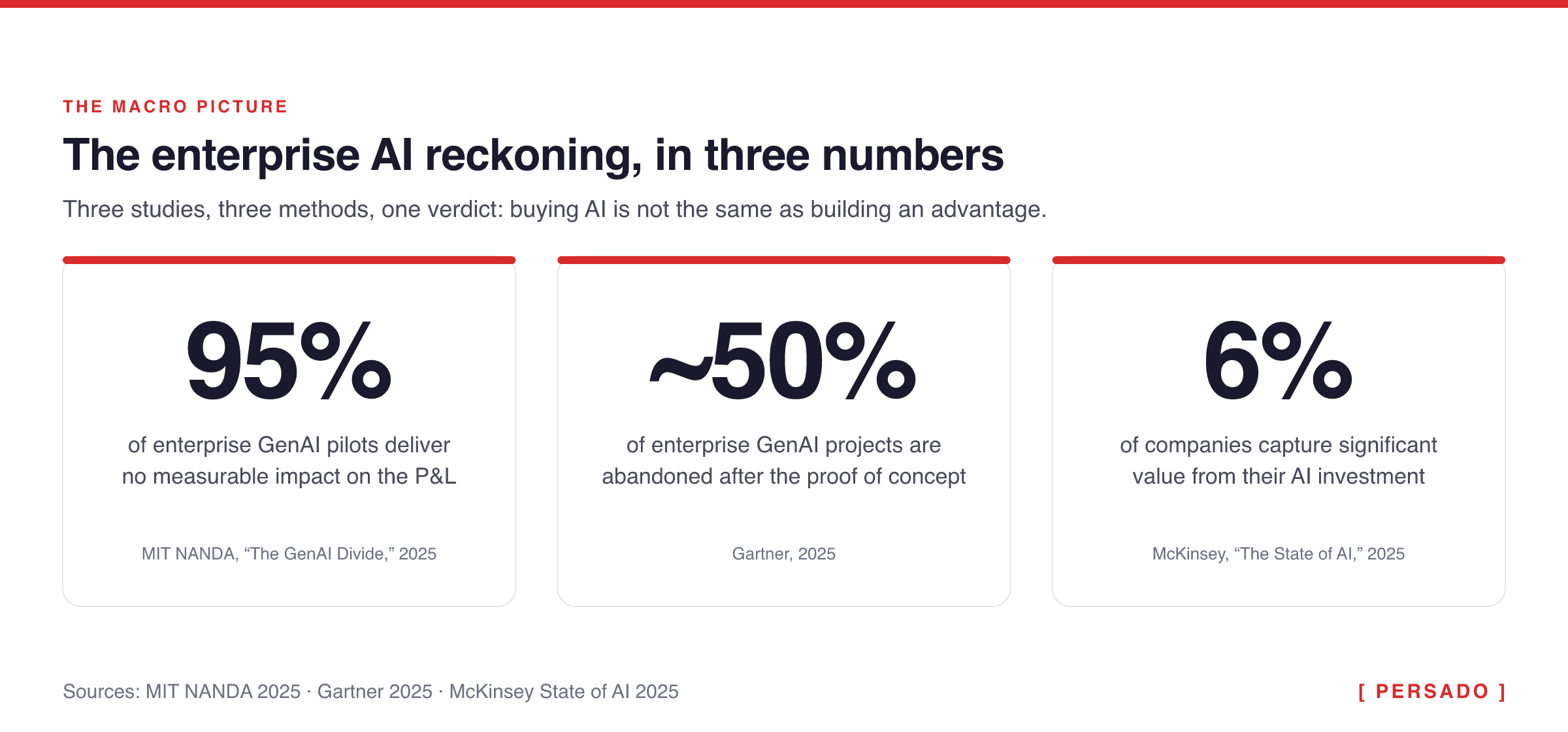 Figure 1 — The enterprise AI reckoning. Three independent studies, three methods, one verdict.
Gartner watched roughly half of enterprise GenAI projects get abandoned after the proof of concept. McKinsey's 2025 survey found that despite near-universal adoption, only about 6% of companies are capturing significant value. The pattern isn't a model problem. Everyone is renting the same frontier model — which is precisely why the model cannot be anyone's advantage. A capability your competitor can license by lunchtime is not a moat. It's a subscription.
In regulated financial services, generic is not merely undifferentiated. It is dangerous. An off-the-shelf model doesn't know your product, your disclosures, or the line your compliance team will not cross — and hallucination, awkwardly, tends to get worse in the more advanced models, not better. Regulators have noticed. FINRA's Notice 25-07 puts AI-generated customer communications squarely inside a firm's recordkeeping and supervision obligations. Every variant is a regulated asset someone has to stand behind. Fast and generic doesn't just underperform here. It creates exposure.
Rented intelligence has no memory
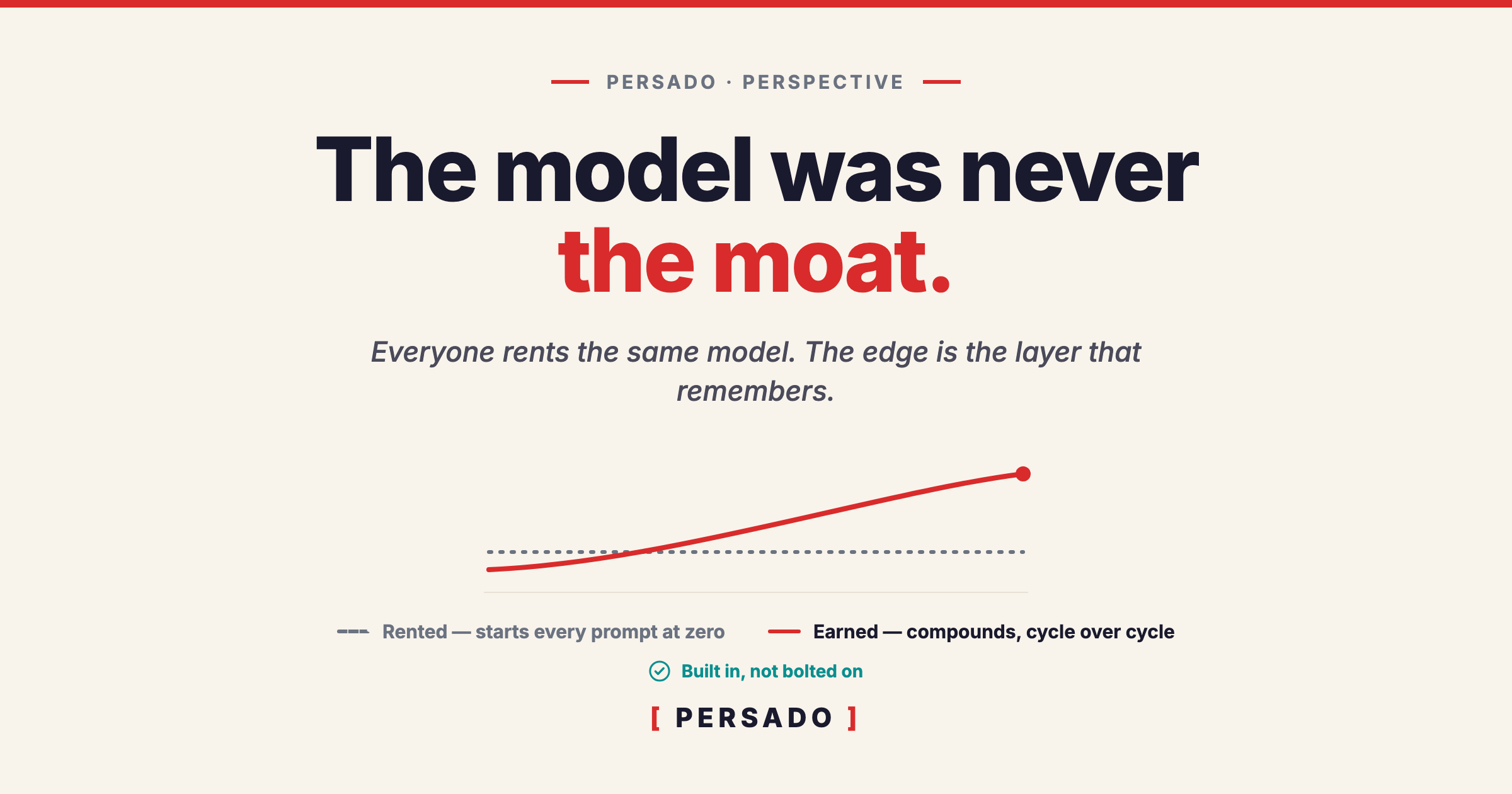
The most useful part of the MIT study is its diagnosis of why the 95% fail. It isn't raw model quality. It's what the researchers call the learning gap — tools that don't retain feedback and don't adapt to the workflow they're dropped into. Put plainly: amnesia.
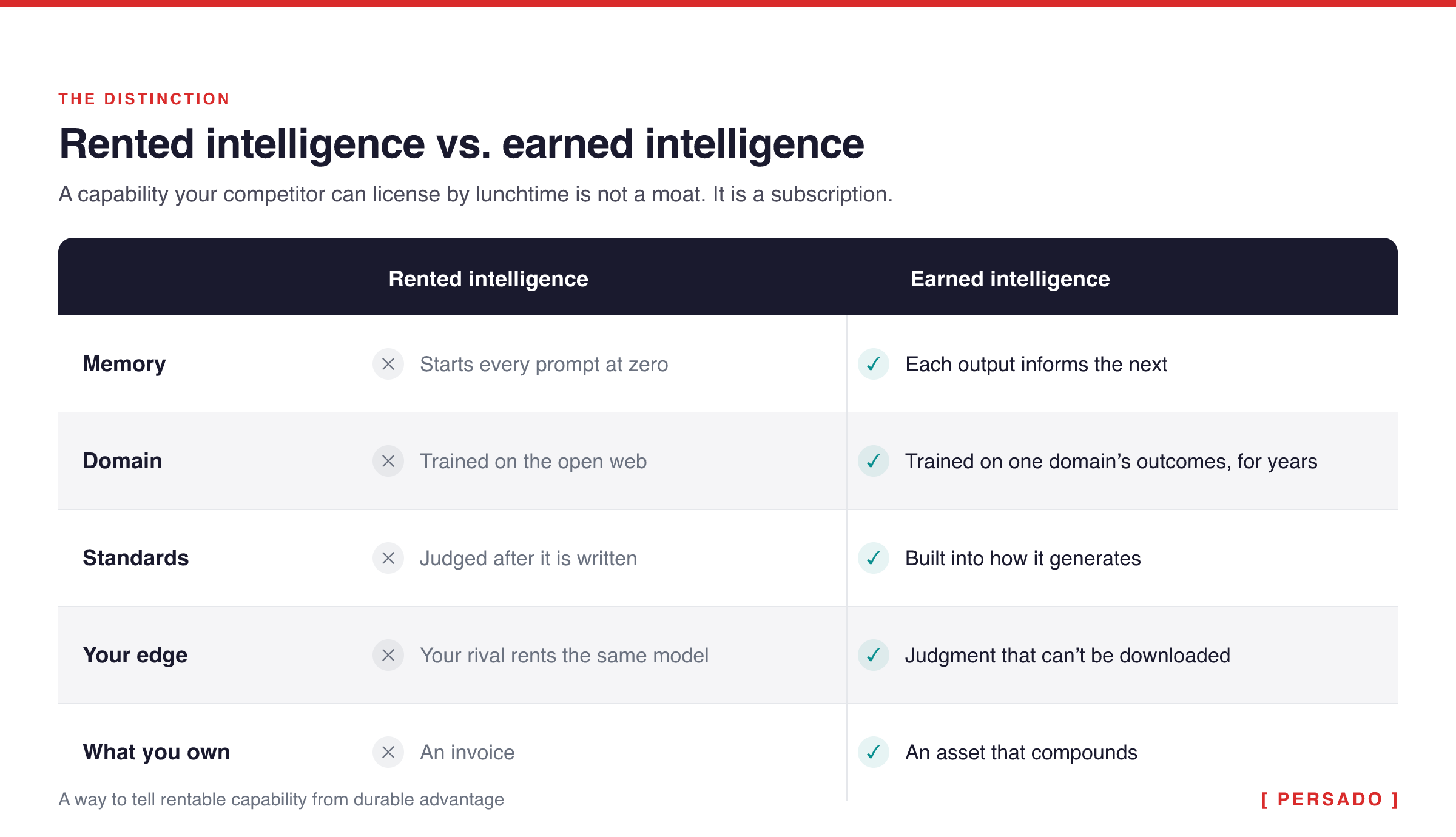 Figure 2 — Rented vs. earned intelligence: the difference is memory.
A rented model doesn't know which subject line your legal team killed last quarter, or why. It doesn't know which emotional appeal converted your cardholders and which one drew complaints. It doesn't remember the decade of campaigns that taught your brand what actually works on your actual customers. Every prompt begins at zero — fluent, confident, and context-free. That's tolerable for the first draft of a birthday email. It is a liability when the output is a disclosure going to a few million regulated consumers.
Karp's word for the thing worth owning is weights. For a marketer, the honest word is memory. The moat was never the model that writes the sentence. It's the accumulated, domain-specific judgment that knows whether the sentence should ever be sent.
The moat is engineered, not downloaded
“They want to know they own the means of production,” Karp said of the enterprises he talks to — “that it's not being transferred to someone else.” Translated out of the infrastructure argument and into marketing, that means something specific: own an intelligence layer trained on your domain, one that gets smarter every time you use it and carries your standards inside it rather than bolted on around it.
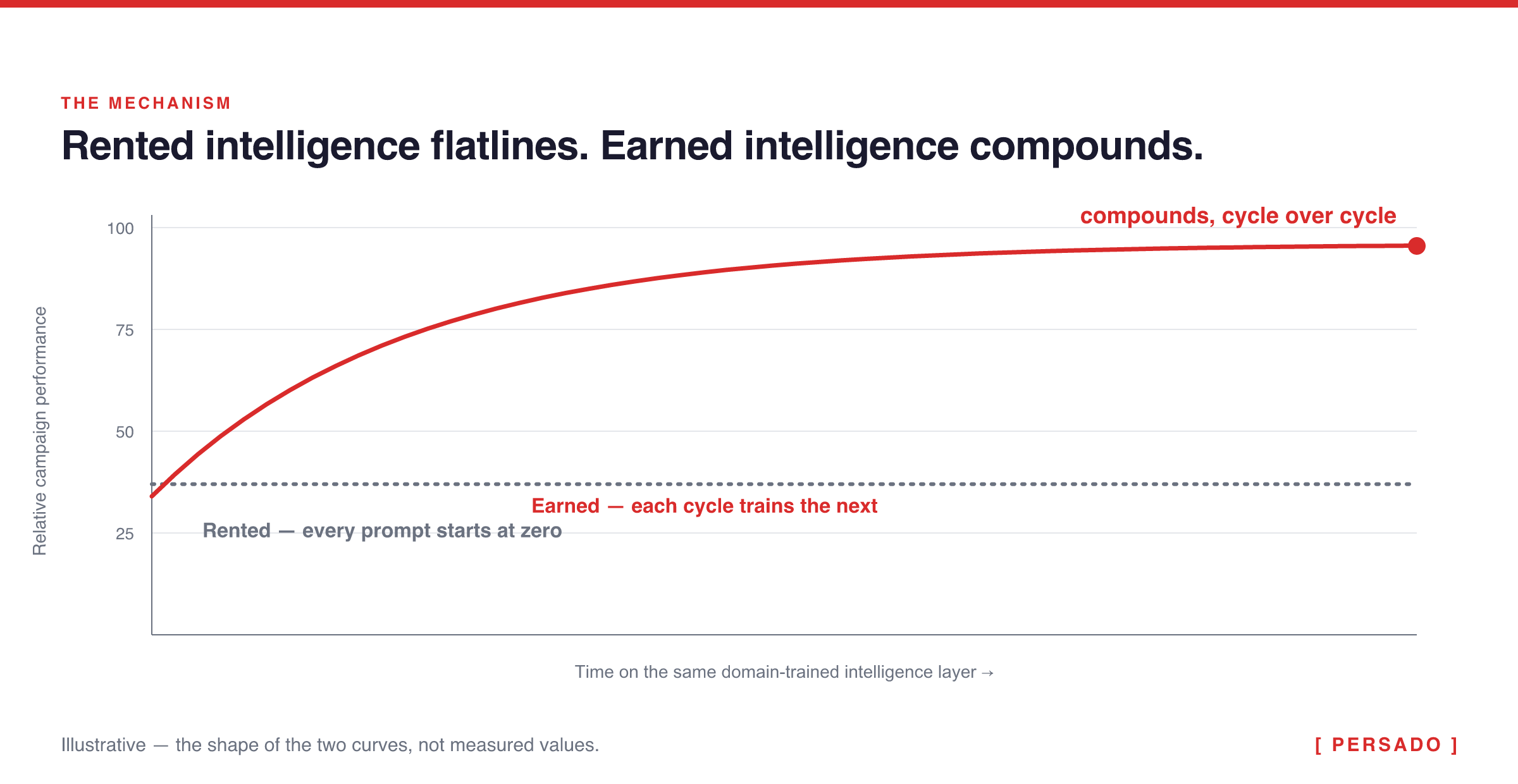 Figure 3 — Rented intelligence flatlines; earned intelligence compounds. Illustrative — the shape of the curves, not measured values.
I've spent the last decade building one of these layers, for the domain where fast-and-generic is most expensive: regulated financial services. So treat what follows as a practitioner's bias, not a pitch. What I've learned is unglamorous. The advantage doesn't come from a cleverer model, or a bigger one. It comes from years of accumulated, outcome-labeled language — which words moved which people to act, and which ones drew a complaint — distilled into something a system can actually reason with. More than two billion messages in, the pattern holds: the value lives in the memory, not the model.
Two things turn that memory into an advantage rather than a hazard. First, judgment stays in the loop where it belongs: the machine proposes at a scale no team could match, but a person still owns the calls that carry the brand and the risk. Second, the standards are built into how the language is generated, not bolted on in a review afterward. In a regulated category, a compliance check that happens after the fact is just an expensive way to learn you have to start over. Built in from the first draft, it's what lets you move quickly without moving recklessly.
None of that is a model achievement. It's a decade of engineered, remembered, domain-specific judgment — the alpha Karp is warning enterprises not to hand away. You can't download it, and you can't rent it by the token. You have to earn it.
Stop renting your judgment
Karp's warning to the enterprise is a warning to the marketer, and it's simpler than the token math makes it sound. The question was never which model you use; your competitor can rent the same one by lunchtime. The question is what you've taught it, what it remembers, and whether it knows the difference between a sentence that converts and a sentence that earns you a call from your regulator.
Speed only stops being a risk when it comes from earned judgment rather than a rented guess. Own the layer that remembers. That's the moat. It always was.
Sources
[1] Alex Karp, CNBC Squawk Box, July 2026 — token-pricing critique; “controlling your weights” / “own the means of production” / alpha framing. Verbatim wording to be confirmed against the primary CNBC transcript before publication.
[2] MIT NANDA, The GenAI Divide: State of AI in Business 2025 — 95% of pilots with no measurable P&L impact; the “learning gap”; majority of GenAI budgets in sales & marketing.
[3] Gartner — enterprise GenAI projects abandoned after proof of concept.
[4] McKinsey, The State of AI 2025 — near-universal adoption; ~6% capturing significant value.
[5] FINRA Regulatory Notice 25-07 (2025) — AI-generated customer communications within recordkeeping and supervision obligations.