The draft was never the hard part. Generic AI tools have made the easy 10% of marketing production — getting a first draft on the page — effectively free. The hard 90% is everything that turns a draft into a published, revenue-driving asset: getting it through compliance review, getting it on-brand, and knowing it will actually perform. For regulated and enterprise marketing teams, flooding the front of the content supply chain with more drafts doesn't relieve the bottleneck. It makes the real one — review and performance uncertainty — measurably worse.
This is a guide for the people who own that supply chain: the Marketing Ops and Marketing Technology leaders responsible for turning content investment into measurable business outcomes. It covers what a content supply chain actually is, where the regulated bottleneck sits, why "more drafts" is the wrong fix, and how to build a supply chain where speed doesn't mean risk.
What a content supply chain is
A content supply chain is the end-to-end system an enterprise uses to industrialize content production — from brief, to creation, to review and approval, to deployment across owned channels, to measurement. The phrase borrows deliberately from manufacturing: it reframes content from a series of one-off creative projects into infrastructure with stages, throughput, and bottlenecks you can measure and improve.
For most enterprises the supply chain already exists — it's just informal, manual, and slow. A deliberate content supply chain strategy is what turns that ad-hoc process into a system you can forecast, govern, and scale. The distinction matters most in regulated industries, where one stage of the chain — review and approval — dominates the cycle time of everything else.
The stages — and where the regulated bottleneck actually sits
Here is the content supply chain as a flow, with the throughput reality for a regulated enterprise (banking, insurance, telco) at each stage:
- Define (brief) — Marketing Manager · Briefs miss compliance and legal triggers up front · Neutral
- Create (draft) — Copy / Design · Drafting is fast — and now nearly free · Floods this stage with volume
- Review & approve — Legal / Compliance · THE BOTTLENECK — multi-week review, 3+ revision cycles · Worsens — more drafts, more to review, no compliance built in
- Build & deploy — Marketing Ops · Manual copy/paste to ESPs; late changes break creative · Neutral-to-worse
- Measure & refresh — Marketing Ops · Approved assets underperform but can't be refreshed without re-triggering review · Worsens — no performance signal before launch
Read the table left to right and the problem is obvious. Stage 2 is the only place generic AI helps, and it's the stage that was never the constraint. The constraint lives at stage 3 (review and approval) and resurfaces at stage 5 (refresh) — and generic GenAI makes both worse, because every additional unreviewed draft adds load to a review function that's already the choke point, and because none of those drafts arrive with compliance validated or performance predicted.
This is the 10/90 rule in operational terms: the draft is the 10%. The 90% — getting it approved, keeping it on-brand and compliant, and knowing it will convert — is where the supply chain breaks.
Why "more drafts" is the wrong fix
The instinct, when content can't ship fast enough, is to produce more of it. Generic AI makes that trivially cheap. But in a regulated content supply chain, drafts are not the scarce resource — approved, proven assets are. Adding draft volume upstream of an unchanged review stage doesn't increase throughput; it lengthens the queue.
Three structural facts make this true for regulated brands specifically — and they're the same three reasons generic GenAI can't fix the bottleneck:
- Compliance is bolted on after, not built in. Generic AI writes the words and disclaims compliance use in its terms. Every output still needs full manual review. The bottleneck stage inherits 100% of the new volume.
- There's no performance signal before launch. A draft is a guess. Without a way to predict performance, every asset that clears review is still a coin flip — so the refresh stage (5) stays broken too.
- Refresh re-triggers review. Even when an approved asset underperforms, changing it sends it back through compliance from the top. So teams leave underperforming-but-approved content live rather than risk the re-approval cycle.
A generic content generation tool cannot, structurally, solve any of these — because it acts only at stage 2, and the problem lives at stages 3 and 5.
The fix: a content supply chain with compliance and performance built into generation
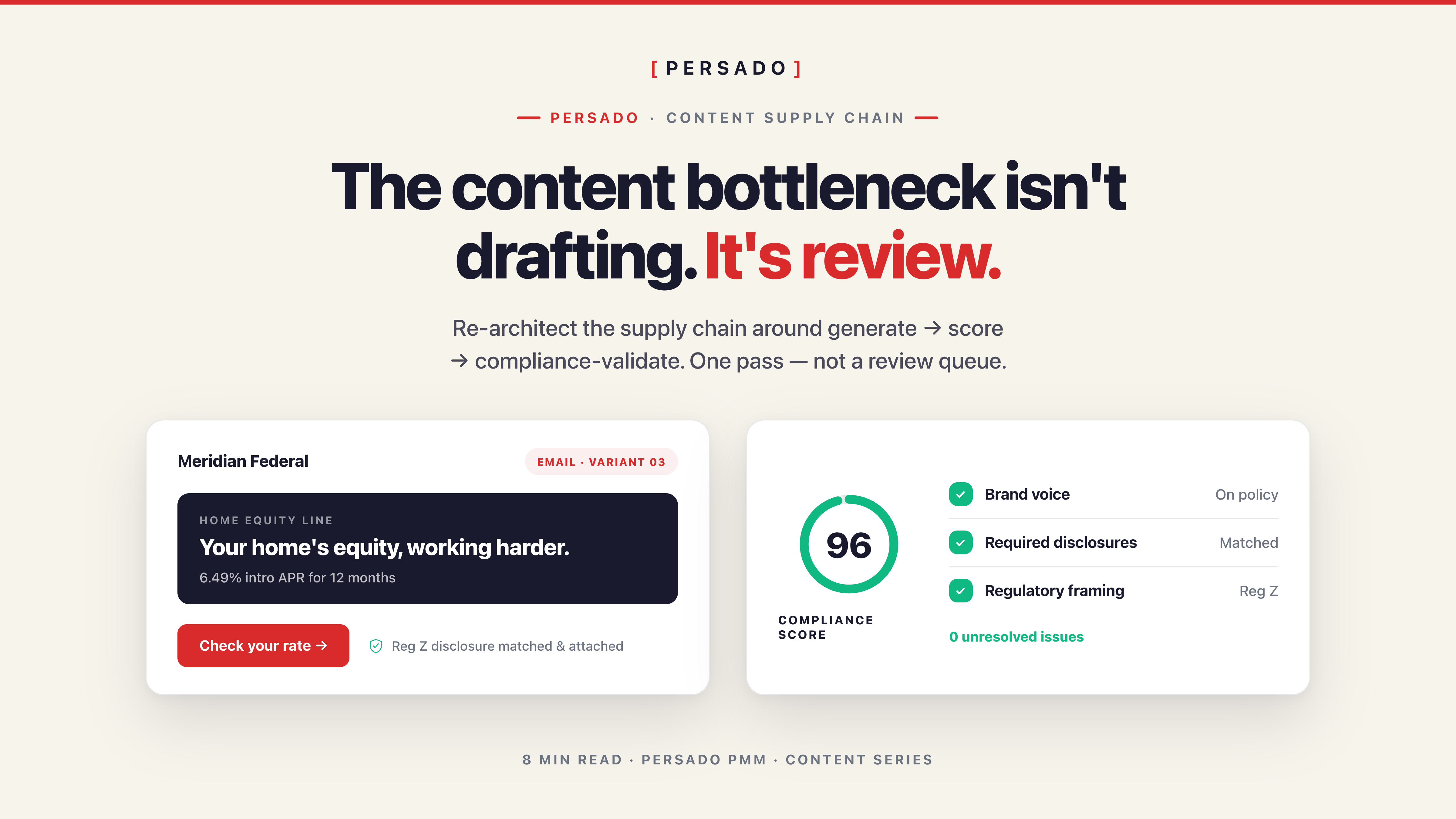
The way out is not a faster draft tool. It's a content supply chain where the two broken stages — review and refresh — are addressed at the point of generation, not after it. That's the system Persado is built for. Instead of generate → then review → then guess, the motion is:
Generate → score → compliance-validate — in one pass, before anything reaches a reviewer.
Concretely, that changes the supply chain at exactly the stages where it breaks:
- At review (stage 3): compliance is validated during generation against 20+ regulatory frameworks, not checked reactively after a draft exists. The result is 90% fewer compliance rejections and first-pass approval — so the bottleneck stage stops being a bottleneck.
- At refresh (stage 5): performance is predicted before launch via the Performance Prediction Score, so Marketing Ops can refresh underperforming approved assets within the existing guardrails — lifting performance without a compliance reset.
This is the difference between a tool that acts on the 10% and a system built for the 90%. Persado delivers production-ready assets in days, not weeks — 4× faster, with a 72-hour average brief-to-market deployment — and does it with zero compliance incidents across a client base that includes 8 of the 10 largest U.S. banks. The performance proof: a 96% win rate against human-written and generic-LLM content, measured across 120K+ campaigns.
That ordering is deliberate. Speed is the universal pain. Cost compounds it. Compliance removes the "why not just use ChatGPT?" objection. And performance — the 96% win rate — is the closer, earned only once the first three are true.
The ROI case for the economic buyer
If you own Marketing Ops, the justification isn't "we'll produce more content." It's "we'll move the same — or more — content through the supply chain faster, at lower cost, without adding compliance risk, and we'll know it converts before it ships."
The economics sit in three places:
- Speed → recovered cycle time. Going from 6–8 week agency cycles to days-not-weeks, with a 72-hour brief-to-market deployment, compresses the single longest line on every campaign timeline.
- Cost → displacement, not addition. A content supply chain rebuilt this way delivers a 75% lower cost on production, and it displaces existing spend rather than adding a new line item — it consolidates budget already going to "how to produce" so it can be reallocated to "what to say."
- Risk and performance → certainty. 90% fewer compliance rejections and zero compliance incidents remove the rework tax; performance prediction before launch removes the guesswork. Over four years, across all comms and measured against control, this approach has driven $2.5B+ in incremental value.
For a Marketing Ops leader building the internal case, the framing is displacement math: you are not asking for new budget, you are re-pointing the budget the supply chain already spends — and removing the rework and re-approval costs that never show up on a line item but dominate the calendar.
The hub: how the content supply chain breaks down
"Content supply chain" is the parent concept. Depending on where you sit, you'll go deeper on one of four child topics — each gets its own dedicated guide, linked here as the hub-and-spoke structure of this resource:
- Content supply chain management → — the operating discipline: how to govern stages, owners, and SLAs across Define → Deploy. (child of this hub)
- Marketing content operation solution → — the tooling and systems view: what a content operation solution must do for a regulated team, and where point tools fall short. (child of this hub)
- Enterprise content supply chain → — scaling the supply chain across business units, brands, and co-branded programs with shared compliance constraints. (child of this hub)
- Digital content supply chain → — the owned-channel, always-on view: web, email, and app/push, where refresh velocity matters most. (child of this hub)
Where to start
If your content supply chain is bottlenecked at review and you're tired of guessing whether assets will perform, the highest-ROI first move is the OPTIMIZE play: refresh your best already-approved assets and lift performance — without a single compliance reset.
See a content supply chain built for regulated marketing. Book a 30-minute walkthrough → — bring one underperforming but approved campaign, and we'll show you the generate → score → compliance-validate motion on it.
![[PRODUCT UPDATE] Three new ways to use Persado](https://a.storyblok.com/f/291846000560732/ec5ff57a41/q3-rundown-cover-v2.png)