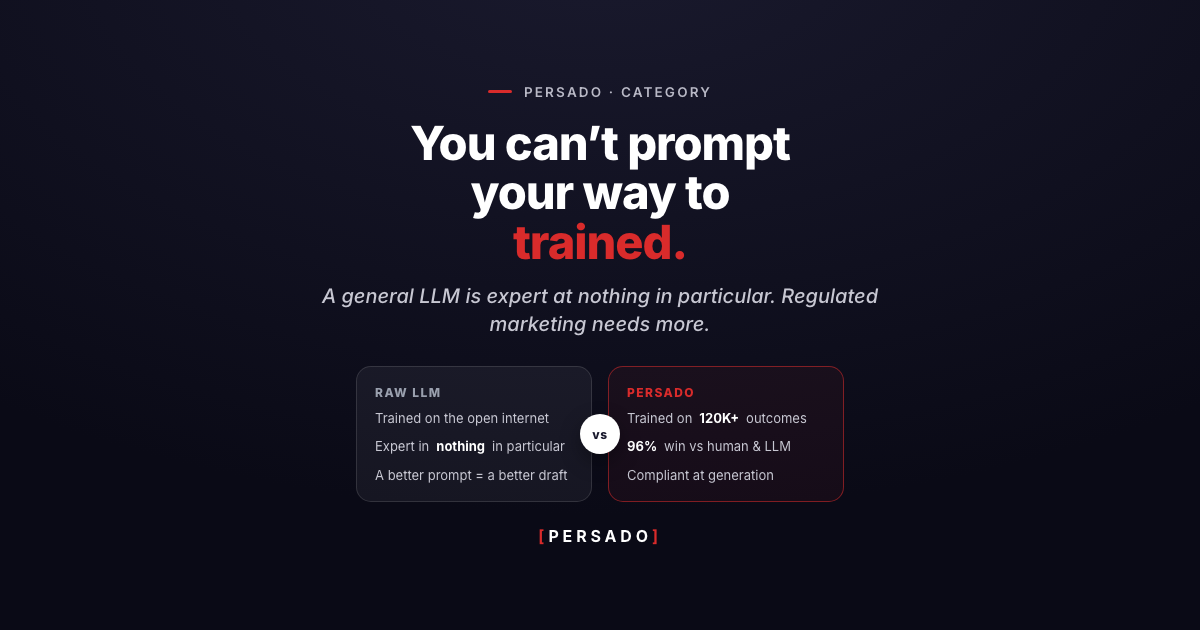
A large language model (LLM) is one kind of generative AI — a model trained to predict the next word and produce fluent text. "Generative AI" is the broader category of systems that produce content, which may be built around an LLM plus training data, retrieval, guardrails, and domain rules. The practical difference for marketing: a raw LLM gives you a plausible draft; a generative AI system built for a purpose can give you a production-ready asset. For regulated brands — banks, lenders, insurers — that gap is the whole decision. A raw LLM is trained on the open internet: everything, and therefore nothing in particular. Prompt it well and you get a better draft. You cannot prompt it into expertise it was never trained to have, and you cannot prompt it into compliance it was never built to enforce.
Generative AI vs LLM at a glance
- What it is — A model that predicts the next token to produce fluent text · A class of systems that generate content — often built around one or more models
- Scope — Language / text specifically · Any generated output: text, images, audio, code
- Trained on — The open internet — broad and general · Can be trained or tuned on specific data: domain outcomes, brand rules, regulation
- What it returns — A plausible draft · A production-ready asset — when the system is built for it
- Domain expertise — Only what's in the general corpus · Only the expertise the system was purpose-built to hold
- Compliance — None built in · Depends entirely on the system — it can be built into generation
The row that matters is the last three. An LLM is a component. A generative AI system is what you build around it — and for regulated marketing, the question isn't "LLM or generative AI?" It's "a general model, or a system trained to perform in your domain and compliant by construction?"
Are LLMs good for marketing copy?
For a first draft, yes. A raw LLM will produce grammatical, on-topic, fluent marketing copy in seconds, and for low-stakes content that is often enough. That is exactly why generic AI has flooded marketing teams.
The trouble starts when the copy has to do a job — convert, and clear compliance — not just read well. A raw LLM was trained to sound plausible, not to perform, and not to comply. It has no memory of which subject line lifted card activations last quarter, no model of what a regulator will reject, and no way to tell you which of ten variants will win before you spend budget finding out. It generates. It does not know.
So the honest answer to "are LLMs good for marketing copy?" is: they are good at drafting, and drafting is the cheapest part of the job. The expensive parts — performance and approval — are the parts a general-purpose model was never trained to solve.
Why a raw LLM isn't enough for regulated marketing
Line up the real cost of a regulated campaign and the draft is the smallest piece. Here is the gap, in the order it actually bites — speed, cost, compliance, then performance.
- Speed. A raw LLM produces a draft fast, but a draft is not a deployable asset. In a regulated org it still has to route through legal and compliance review — the 6-to-8-week bottleneck the AI was supposed to remove. Fast drafting doesn't fix a slow approval path; it just relocates the wait. A system built for regulated marketing produces production-ready assets in days, not weeks, with first-pass approval — because approval isn't a stage after generation, it's a property of it.
- Cost. Every draft a raw LLM writes that later fails review is rework — the most expensive kind of content, because you paid to make it, paid to review it, and paid to make it again. Building the guardrails into generation is what removes that rework. Persado deployments run at 75% lower cost, not by writing cheaper drafts but by not writing the wrong ones.
- Compliance. This is the gate, and it is structural. A raw LLM with a compliance review bolted on afterward generates first and checks later — the check is a gate, not a constraint on what gets generated. By the time a non-compliant claim exists, it has already been written. Persado validates compliance during generation, against 20+ regulatory frameworks, on every variant before it reaches a reviewer. Across deployments: 90% fewer compliance rejections and zero compliance incidents. That is the difference between inspecting the damage and preventing it.
- Performance. Here is the moat, and it is the reason prompting can't close the gap. A raw LLM is trained on the open internet — the average of everything ever written, which is expert at nothing in particular. Persado is trained on real performance outcomes in regulated, high-stakes marketing: 1T+ messages analyzed and 120K+ performance-labeled campaigns, distilled into a Performance Prediction Score that ranks variants before launch. The result is a 96% win rate versus human-written and generic-LLM content, across those 120K+ campaigns. You can prompt an LLM into a better sentence. You cannot prompt it into a decade of labeled outcomes it never saw.
That last point is the one to sit with. Prompt engineering improves how a model expresses what it already knows. It cannot add expertise the model was never trained on. A general LLM was never trained to win in your category, and no prompt retroactively trains it. This is why "generative AI vs LLM" is the wrong axis for a regulated marketer, and "generic model vs system trained to perform" is the right one.
Is a large language model enough for enterprise marketing?
For a marketing team without regulatory exposure and without a performance mandate, a raw LLM can be a real productivity tool. Enterprise regulated marketing is neither. It has a named regulator, a legal review path, millions of customers, and messaging tied directly to applications, activations, and revenue. In that environment a raw LLM solves the easy 10% — the draft — and leaves the hard 90% untouched: will it perform, and will it clear.
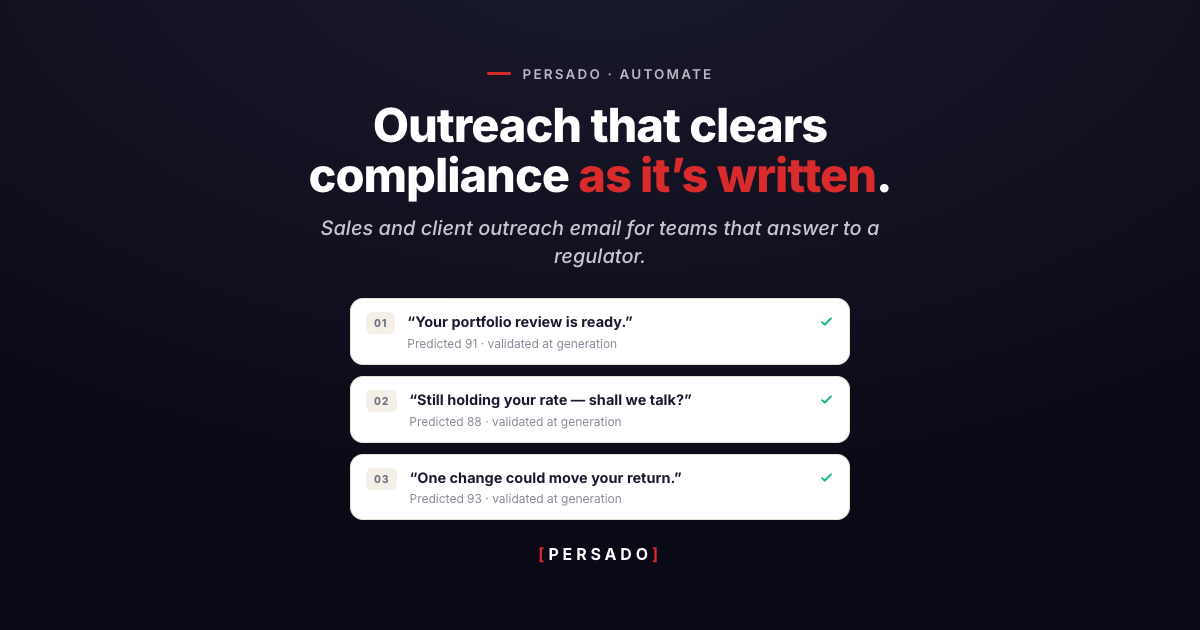
A raw LLM generates a draft. A generative AI system built for regulated marketing is trained to perform and compliant by construction. Persado is the second kind: the only regulated-ready creative system purpose-built for financial services, with compliance validation built into generation, not bolted on after review. That is not a bigger model or a better prompt. It is a different category of tool — a content supply chain rather than a text generator. Fast doesn't mean risky.
FAQ
What is the difference between generative AI and an LLM?
An LLM (large language model) is one type of generative AI: a model trained to predict the next word and produce fluent text. Generative AI is the broader category of systems that produce content — text, images, audio, or code — often built around one or more models plus training data, retrieval, and rules. Put simply, every LLM is generative AI, but generative AI is more than an LLM. The practical difference for marketing is that a raw LLM returns a draft, while a generative AI system built for a purpose can return a production-ready, compliant asset.
Are LLMs good for marketing copy?
For first drafts, yes — a raw LLM produces fluent, on-topic marketing copy quickly. But drafting is the cheapest part of the job. An LLM was trained to sound plausible, not to perform or to comply, so it can't tell you which variant will win before launch and it has no compliance rules built in. For low-stakes content that's fine; for regulated or revenue-driving marketing, a draft still has to be made to perform and made to pass review — the expensive parts a general model wasn't trained to solve.
Can I use ChatGPT for regulated marketing copy?
It's risky. A general-purpose LLM has no regulatory frameworks built into generation, so every output needs manual compliance review afterward — and reviewing after generation inspects the damage, it doesn't prevent it. It also has no model of your past performance, so it can't predict what will convert. For regulated marketing, the safer approach is a system that validates compliance during generation, against the frameworks that apply to you, on every variant — rather than a generic model with a review step bolted on.
Is a large language model enough for enterprise marketing?
Not for regulated enterprise marketing. A raw LLM solves drafting but leaves the hard parts — performance and approval — untouched. Enterprise regulated marketing has a named regulator, a legal review path, and messaging tied to revenue, so it needs a system trained on real performance outcomes and compliant by construction, not a general model trained on the open internet. A raw LLM generates a draft; a purpose-built generative AI system produces a production-ready, compliant, high-performing asset.
![[PRODUCT UPDATE] Three new ways to use Persado](https://a.storyblok.com/f/291846000560732/ec5ff57a41/q3-rundown-cover-v2.png)