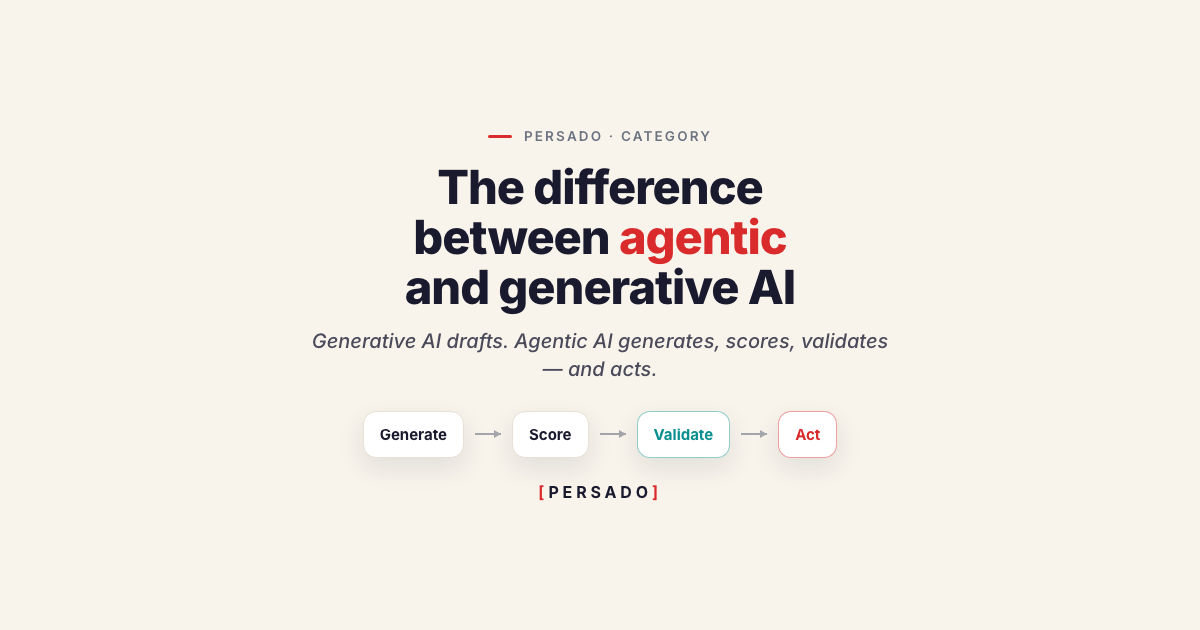
Generative AI drafts. Agentic AI acts. A generative AI tool completes one step: you prompt it, it returns a draft, and a person takes it from there. An agentic AI system runs the whole loop — it generates content, scores it against predicted performance, validates it for compliance, and acts within defined guardrails, with no manual hand-off between steps. The difference isn't a smarter model. It's the difference between a tool you operate and a system that operates.
For marketing, that structural difference decides what you can safely automate. For regulated marketing — banks, lenders, insurers, telco, gaming — it decides whether you can automate at all.
Agentic AI vs generative AI at a glance
- What it does — Produces a draft on request · Runs a workflow: generate → score → validate → act
- Unit of work — One step (a completion) · A system (a governed loop)
- Human role — Reviews and finishes every output · Sets the guardrails; the system operates inside them
- Compliance — Reviewed after generation, if at all · Validated during generation, on every variant
- Performance — Unknown until it ships · Scored before it ships
- Memory — Stateless — each prompt starts over · Cumulative — each asset makes the next one smarter
- Best for — First drafts, ideation · Production at scale under constraints
A generative model is one component of an agentic system — the drafting step. What makes a system agentic is everything wrapped around that step: the scoring, the validation, and the authority to act within limits a human set. Miss those, and you have a faster way to produce drafts, not a system that can run a workflow.
What is agentic AI?
Agentic AI is software that pursues a goal across multiple steps — planning, generating, evaluating, and taking action — inside boundaries a human defines, rather than returning a single output for a person to use. What "agentic" means is autonomy under governance: the system decides the next move, but only within the guardrails it was given.
The distinction from generative AI is structural, not a matter of degree:
- Generative AI answers "make me something." It maps a prompt to an output and stops.
- Agentic AI answers "get this done, within these rules." It chains steps toward an outcome, checks its own work, and executes — a governed agent workflow, not a single completion.
That last phrase matters for anyone who ships content under constraints. An agent that can act without checking its work at each step is a liability. An agent that checks the right things — performance and compliance — before it acts is the point.
Agentic AI vs LLM: why they aren't the same thing
An LLM (large language model) is the engine that generates text. Agentic AI is the vehicle built around it. Asking "agentic AI vs LLM" is like asking "car vs engine" — one is a part of the other.
An LLM on its own is stateless and unconstrained: it produces plausible language and has no built-in sense of whether that language will perform, or whether it's allowed. An agentic system adds the parts an LLM lacks — a scoring model to predict performance, a validation layer to enforce rules, and the logic to act on the result. That's why "a generic LLM with a compliance checkbox bolted on" is not agentic AI for regulated marketing. The checkbox is a gate after the fact; it never shapes what gets generated. Reviewing an output after it exists doesn't control what the system produces — it just inspects the damage once it's done.
Agentic AI for marketing
Agentic AI for marketing is a system that doesn't stop at writing copy. It generates message variants, predicts which will perform, checks each one against brand and regulatory rules, deploys the winner into the channel, and keeps optimizing in real time by segment — without a human re-touching every step. Generative AI gives a marketer a faster first draft. Agentic AI gives a marketing team a governed workflow that runs.
What is agentic AI marketing, concretely?
Concretely, agentic AI marketing replaces the manual chain — write, route for review, wait for approval, load into the ESP, monitor, refresh — with a loop the system runs itself, inside limits you set. The team defines the guardrails: the brand voice, the offer rules, the regulatory frameworks that apply. The system produces segment-specific content, scores it, validates it, and delivers straight-through output into the channel. When performance drifts, it refreshes — within the same guardrails, so nothing has to re-enter review.
This is why "agentic" is more than a faster generator. A faster generator still hands every output to a person. An agentic system removes the manual refresh cycles and template sprawl that eat a lifecycle team's week — while keeping a human in control of the rules, not the keystrokes.
Agentic AI for regulated marketing: the version generic AI can't do
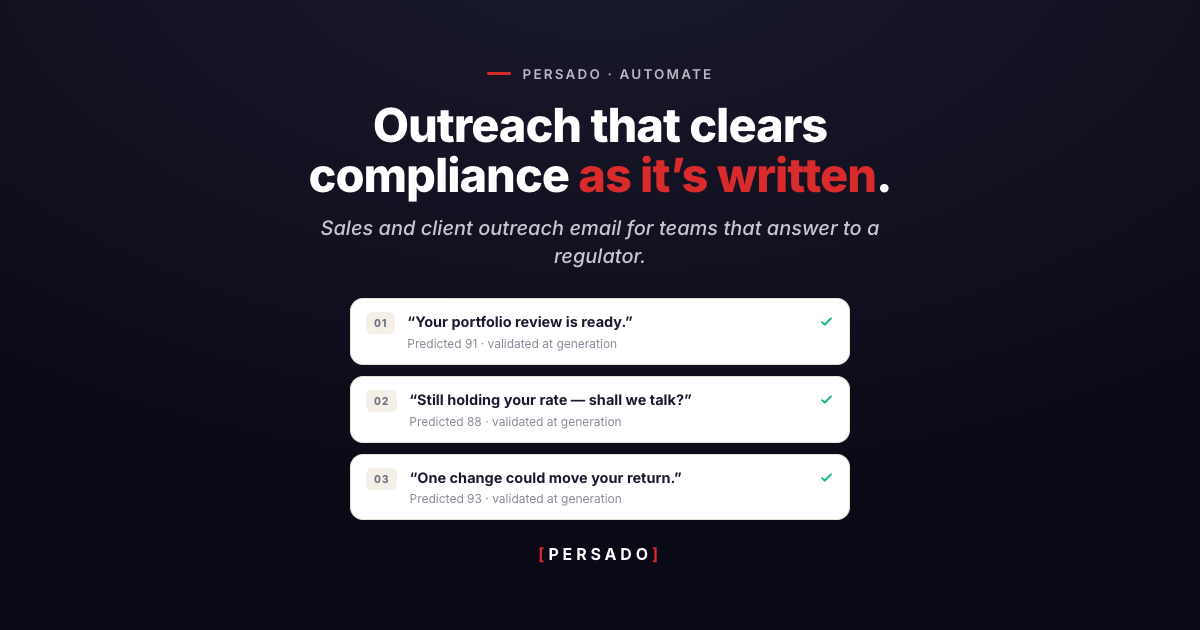
Here is the category line, and it's structural. Generic generative AI generates first and checks later — if it checks at all. For a bank, a lender, or an insurer, "check later" is the whole risk. Every message is constrained by a regulator, and an output that's already been generated in a non-compliant form is already an exposure. The only way to automate messaging safely under regulation is to make compliance a condition of generation, not a review step after it.
That's the distinction Persado is built on: agentic AI for regulated marketing — not a generic LLM with a compliance checkbox. The system generates, scores every variant with a Performance Prediction Score, validates it against the regulatory frameworks that apply, and acts within guardrails — as one governed loop. Here's how that holds up against the four things generic generative AI structurally cannot promise, in the order they matter.
- Speed. Production-ready assets in days, not weeks — a 4× faster, 72-hour average brief-to-market deployment. An agentic loop doesn't wait on a manual hand-off between generate and approve.
- Cost. 75% lower cost. When compliance is a condition of generation, the rework that makes content expensive to ship — the review-reject-rewrite cycle — largely disappears.
- Compliance. This is the gate. Persado validates every variant during generation against 20+ regulatory frameworks, with 100K+ message elements pre-validated for financial services. The result across deployments: 90% fewer compliance rejections and zero compliance incidents.
- Performance. Persado content wins a 96% win rate versus human-written and generic-LLM content, across 120K+ campaigns — and the scoring gets sharper with scale, because each asset makes the next one smarter. Over four years, across all comms, Persado has driven $2.5B+ in incremental value versus control.
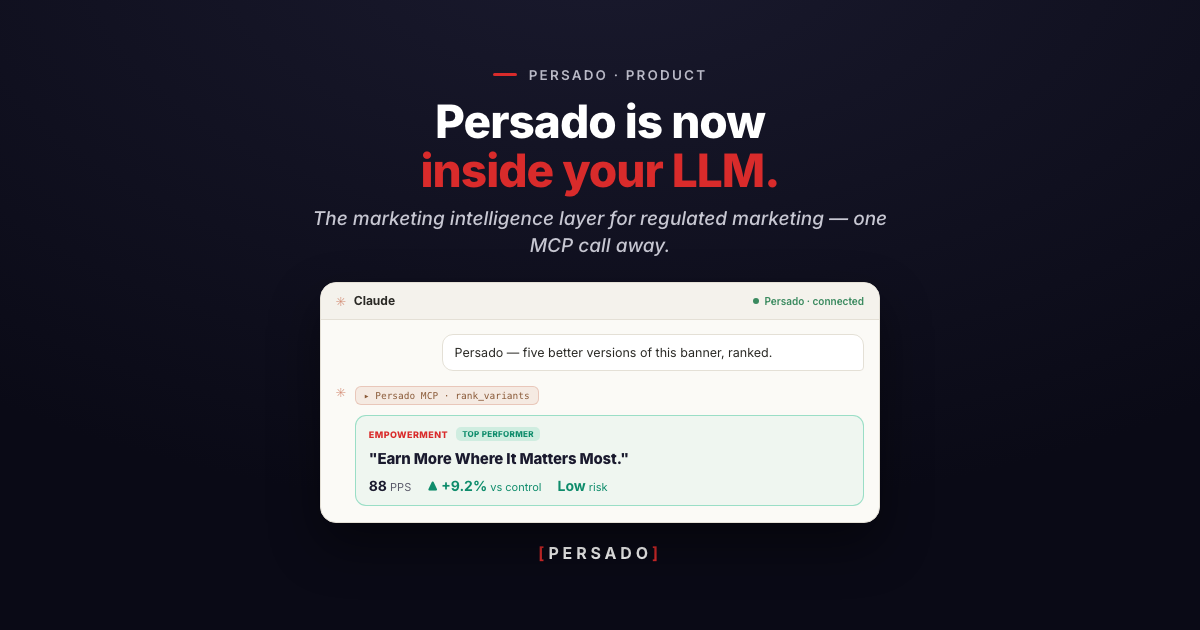
The Performance Prediction Score is the scoring step made explicit — and it isn't a black box. It's a model-generated ranking per variant, built on 1T+ messages analyzed and 120K+ performance-labeled campaigns, so the system can predict what will work before it ships instead of finding out after. That's the "score" in generate → score → validate → act. A generic LLM has no such step; it produces language and hopes.
For a lifecycle or CRM team, this lands in the stack you already run. Persado embeds in your CDP/ESP — SFMC, Adobe Campaign, Movable Ink — so real-time optimization and segment-specific content flow into existing channels rather than becoming another silo. Fast doesn't mean risky: that's only true when speed and compliance are engineered together, which is exactly what an agentic system — not a generative tool — makes possible.
FAQ
What is agentic AI?
Agentic AI is software that pursues a goal across multiple steps — planning, generating, evaluating, and taking action — inside boundaries a human defines, instead of returning a single output for a person to finish. Where generative AI maps a prompt to one output and stops, an agentic system chains steps toward an outcome, checks its own work, and acts within its guardrails. In marketing, that means generating content, scoring it for predicted performance, validating it for compliance, and deploying it — as one governed workflow rather than a series of manual hand-offs.
What does agentic AI mean?
"Agentic" means autonomy under governance: the system decides the next move, but only within limits a human set. It's the difference between a tool you operate step by step and a system that runs a workflow on your behalf, inside your rules. The word signals that the software has agency — it can take action toward a goal — not that it acts without control. Well-designed agentic AI keeps the human in charge of the guardrails while the system handles the execution inside them.
What is agentic AI vs generative AI?
Generative AI drafts; agentic AI acts. Generative AI completes one step — you prompt it, it returns a draft, a person takes over. Agentic AI runs the full loop: it generates, scores the output against predicted performance, validates it against the rules that apply, and acts within defined guardrails, with no manual hand-off between steps. A generative model is one component of an agentic system — the drafting step. What makes a system agentic is the scoring, validation, and governed action wrapped around that step.
What is the difference between agentic AI and an LLM?
An LLM (large language model) is the engine that generates text; agentic AI is the system built around it. An LLM on its own is stateless and unconstrained — it produces plausible language with no built-in sense of whether that language will perform or whether it's allowed. An agentic system adds what the LLM lacks: a model to predict performance, a layer to validate against rules, and the logic to act on the result. Asking "agentic AI vs LLM" is like asking "car vs engine" — one is a part of the other.
What are the use cases for agentic AI in regulated marketing?
In regulated marketing, agentic AI use cases center on automating messaging that a regulator constrains — safely. Examples: generating and deploying segment-specific lifecycle content (onboarding, activation, cross-sell, retention) across email, app, and push with compliance validated on every variant; refreshing underperforming approved assets without a compliance reset; and running real-time optimization inside a CDP/ESP so messages adapt by segment without manual refresh cycles. The common thread is that compliance is a condition of generation, so a team can automate at scale without a generic AI's after-the-fact review risk.
![[PRODUCT UPDATE] Three new ways to use Persado](https://a.storyblok.com/f/291846000560732/ec5ff57a41/q3-rundown-cover-v2.png)