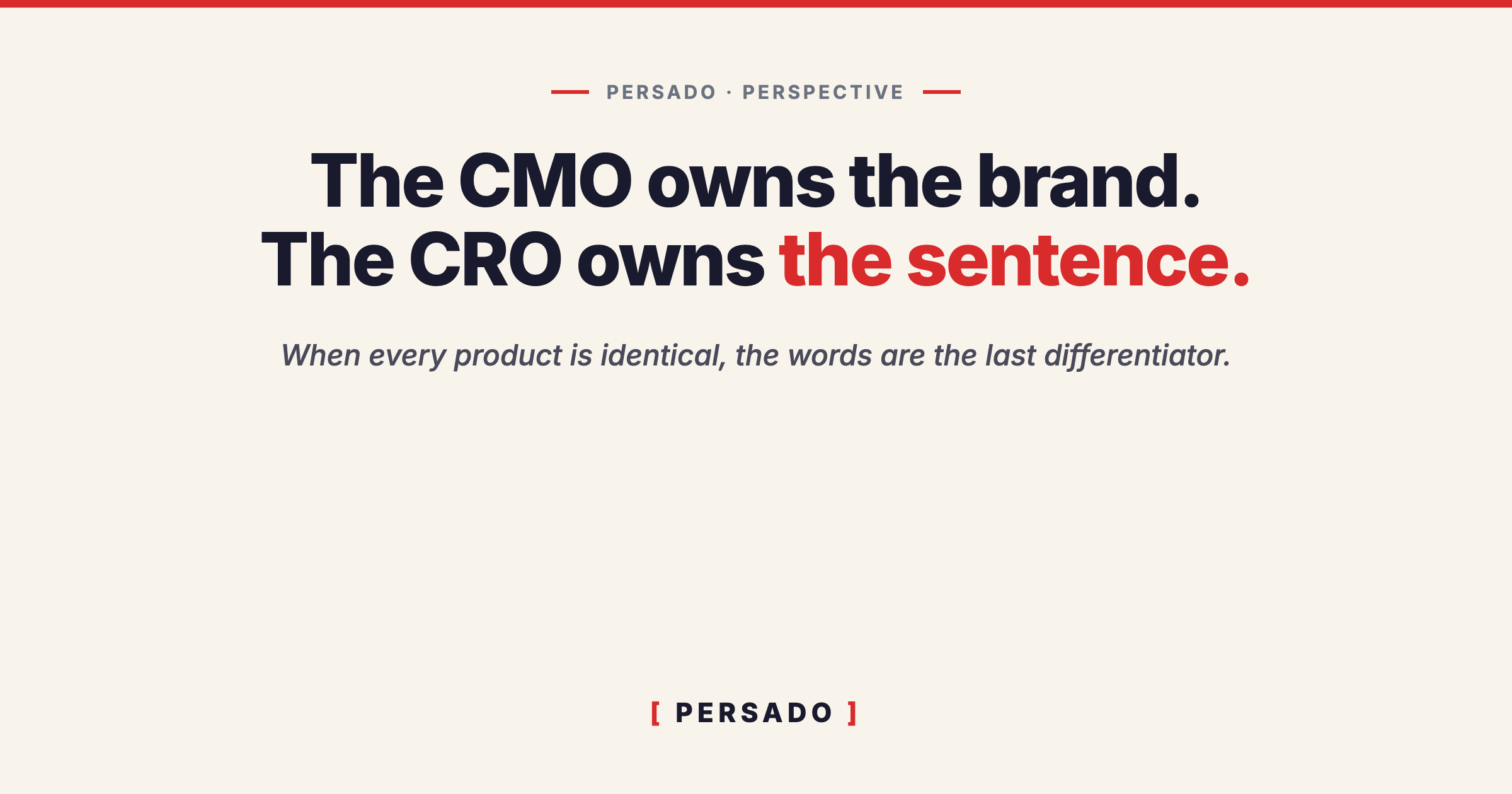
In a category where every product is nearly identical, the words are the last differentiator. That turns language into a revenue lever, not a production line.
Put two premium travel cards side by side. The annual fees are within fifty dollars of each other. The lounge networks overlap. The rewards are 3× on dining, give or take a category. On the spec sheet, they are interchangeable. The only thing that is not identical is how each one asks for the application: the subject line, the way the offer is framed, the sentence that makes someone feel the upgrade is already theirs. That sentence is doing the entire job of differentiation. And in most banks, no one on the revenue side owns it.
That is the quiet problem in financial-services marketing. The industry has spent a decade commoditizing the product, matching every competitor's APR, rewards, and fee structure to within a rounding error, and never quite noticing that it handed the last source of differentiation to whoever happened to be writing the copy that week.
The most valuable lever is the least owned
Nielsen has put a number on this more than once: the creative, the message itself, is the single largest driver of advertising performance, ahead of targeting, reach, and spend. Not a rounding factor. Roughly half of the outcome. If you carry a number for a living, that should stop you cold, because it means the biggest lever on your conversion rate is the input you most likely treat as a production cost. Media gets a director and a dashboard. Targeting gets a data-science team. The words get a brief, an agency round, and a legal review. Then everything downstream gets measured as if the words were fixed.
Brand is the CMO's. The sentence is the CRO's.
The gap here is ownership. The CMO rightly owns the brand: the promise, the identity, the long arc of how a market feels about you. But the specific sentence that converts a specific person at a specific moment is a revenue instrument. It moves your funnel this quarter. When the product is commoditized, that sentence is the differentiator, so it belongs on the revenue side of the house, measured and owned like any other performance asset.
The reason it usually isn't comes down to a habit of mind. The habit is to treat language as something you produce, not something you engineer. Producing is a cost center: delegate it, cheapen it, get it approved. Engineering is a performance discipline: measure it, learn from it, compound it. Same words. A completely different relationship to your P&L.
AI will make this worse before it makes it better
Generative AI has made words nearly free to produce. The reflex, especially under CFO pressure, is to book that as a production win: same copy, cheaper. But if language is your last differentiator, “cheaper average copy, at scale” is exactly the wrong trade. You would be industrializing the commodity and skipping the differentiator. The teams that pull ahead will do the opposite: use AI to treat every message as a measured bet on conversion, scored before it ships and learned from after, instead of a draft to be produced and forgotten.
I run revenue at a company built on that premise, so consider my bias disclosed. You do not have to take the vendor's word for it. Look at your own funnel and ask one question: who owns the sentence that converts? If the honest answer is “the agency,” or “whoever's in the brief,” or “the model we prompt,” then the single biggest lever on your conversion rate is the one thing no one on your revenue team is managing.
The line where the revenue lives
The CMO owns the brand. The CRO owns the sentence. In a category where the products are the same, that is not a boundary dispute. It is a map of where the revenue comes from, and a warning about the one asset you cannot afford to keep treating as a cost.
Sources
Nielsen: creative is the single largest driver of advertising ROI, ahead of reach and targeting. (Confirm the exact share before publication.)
McKinsey, The State of AI 2025: value concentrates in companies that pair AI with growth and innovation objectives, not cost reduction alone.