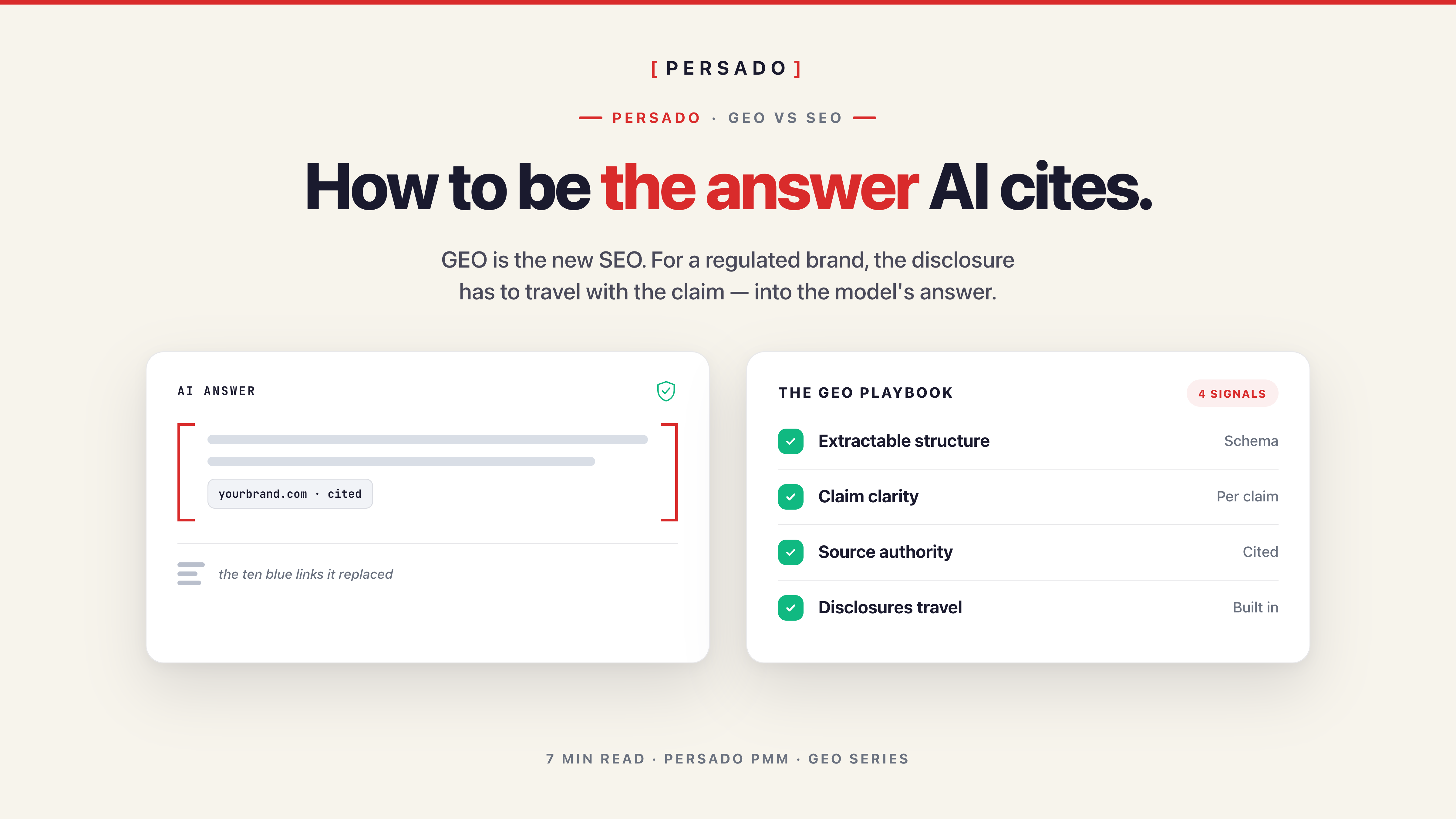
GEO (Generative Engine Optimization) is the practice of getting your content cited inside AI-generated answers — in Google's AI Overviews, ChatGPT, Perplexity, and Gemini. SEO optimizes to rank in a list of links. GEO optimizes to be the answer. For regulated brands, the difference is not cosmetic: when an AI engine quotes you, it is repeating your claims to a customer with no intermediate page for a disclosure to live on. The content has to be authoritative enough to be cited — and compliant enough to be safe when it is.
That second requirement is where generic AI tooling breaks down, and where the category splits.
GEO vs SEO at a glance
- Goal — Rank a page in a list of links · Get cited inside an AI-generated answer
- Surface — Blue-link results pages · AI Overviews, ChatGPT, Perplexity, Gemini
- Unit of success — Position 1–10 · Inclusion + attribution in the answer
- What the engine rewards — Keywords, backlinks, page authority · Clear claims, structure, extractable answers, source authority
- User behavior — Click through to your site · Reads the synthesized answer, may never click
- Where the risk sits — On your page, with your disclosures · In the answer, stripped of your page context
- For regulated brands — Compliance reviewed before publish · Compliance must hold even when the claim is quoted alone
SEO is not going away — the two run together. But the surface that increasingly decides whether a customer ever sees your brand is the AI-answer layer, and that layer rewards different things.
What is generative engine optimization?
Generative engine optimization is the discipline of structuring and writing content so that generative AI engines select it, trust it, and reproduce it inside their answers. Where SEO asks "will this page rank?", GEO asks "will an AI engine quote this — accurately, and attributed to us?"
Three things make content GEO-eligible:
- Extractable structure. Answer-first paragraphs, clear headings, and schema (FAQPage, Article) give the engine clean, quotable units.
- Claim clarity. Specific, self-contained statements travel better than hedged prose, because the engine lifts them out of context.
- Source authority. Engines weight content from sources they can corroborate — consistent, credible, and internally non-contradictory.
For most brands, that is the whole job. For regulated brands, a fourth requirement is non-negotiable, and it changes the tooling you can use.
Generative engine optimization marketing: why regulated brands play a different game
When an AI engine cites a bank, a lender, or an insurer, it does something a search result never did: it detaches your claim from your page. The disclosure in your footer, the rate qualifier next to your CTA, the "representative example" beside your offer — the engine may not carry any of it into the answer. The customer sees the claim alone.
That is a compliance exposure that scales with every AI citation you earn. And it is the exact point where a generic large language model with a compliance review bolted on afterward is the wrong tool. Reviewing AI output after generation does not control what gets generated; it just inspects the damage. By the time a non-compliant claim has been written, it has already been written in a form an engine can lift.
This is the category distinction, and it is structural, not a feature gap:
- A generic LLM with a compliance checkbox generates first and checks later. The check is a gate, not a constraint on generation.
- An agentic creative system built for regulated marketing validates compliance during generation — every variant, before it ever reaches an engine.
Persado is the second kind. We are the regulated-ready creative system purpose-built for financial services: compliance validation built into generation, not bolted on after review. For GEO, that is the whole difference between content that is safe to be quoted and content you have to hope is never quoted out of context.
GEO for regulated brands: how to win the AI-answer layer without legal risk
The discipline is the same four-part GEO playbook everyone runs — extractable structure, claim clarity, source authority, schema — executed under a constraint generic tooling can't satisfy: every claim must be compliant the moment it is generated, because the AI answer layer strips the context your disclosures used to provide. Here is how the messaging hierarchy maps to it.
- Speed. AI engines refresh their answers continuously. Winning the answer layer is a volume and velocity game — you need authoritative, compliant content faster than a 6–8-week agency cycle can produce it. Persado delivers production-ready assets in days, not weeks, with first-pass approval.
- Cost. Producing GEO-grade content at the cadence the answer layer demands is expensive when every asset routes through a full compliance review. Engineering compliance into generation removes the rework that makes content costly to ship.
- Compliance. This is the gate. Persado validates compliance during generation against 20+ regulatory frameworks — so the claim an engine quotes is already cleared, not pending review. Across deployments: 90% fewer compliance rejections and zero compliance incidents.
- Performance. Authority is what gets you cited. Persado content wins a 96% win rate vs. human-written and generic-LLM content, across 120K+ campaigns — the kind of demonstrated effectiveness that makes a source worth quoting.
The point is not "use AI to write faster." Generic AI does that and creates risk. The point is that the answer layer rewards content that is simultaneously authoritative and compliant, and only a system that engineers both together can produce it at the speed the layer demands. Fast doesn't mean risky.
How to start optimizing for generative engines
A practical sequence for a regulated marketing team:
- Audit where you're already cited (and where competitors are). Query AI Overviews, ChatGPT, and Perplexity on your category terms; note who gets quoted.
- Make your highest-authority content extractable. Answer-first paragraphs, clean H2/H3 structure, FAQPage and Article schema on definitional and question pages.
- Treat every claim as if it will be quoted alone. If a sentence isn't safe stripped of its page context, it isn't GEO-ready — and for a regulated brand, it isn't publish-ready.
- Build compliance into generation, not review. This is the step that lets you produce at AI- answer-layer cadence without a compliance reset on every refresh.
Steps 1–3 are standard GEO. Step 4 is the one that decides whether a regulated brand can run GEO at scale at all.
FAQ
How does generative engine optimization work?
Generative engine optimization works by structuring and writing content so AI engines can extract, trust, and reproduce it inside their answers. Engines favor content with clear, answer-first structure, specific self-contained claims, supporting schema (FAQPage, Article), and corroborated source authority. Instead of optimizing to rank a link, you optimize to be the quoted source in the generated answer.
Why is generative engine optimization important?
Search is shifting from lists of links to AI-generated answers in AI Overviews, ChatGPT, Perplexity, and Gemini. Increasingly, the AI answer is the only thing many users see — so if your content isn't cited there, your brand is absent from the moment of decision. For regulated brands the stakes are higher: when an engine quotes your claim, it does so without the disclosures on your page, so the content must be both authoritative and compliant on its own.
Is generative engine optimization the same as traditional SEO?
No. Traditional SEO optimizes a page to rank in a list of links; generative engine optimization optimizes content to be cited inside an AI-generated answer. They share fundamentals — quality, structure, authority — but differ in goal, surface, and how success is measured. They run together: strong SEO supports GEO, but GEO requires extra work on extractability, claim clarity, and schema.
Is answer engine optimization and generative engine optimization the same?
They overlap and are often used interchangeably, with a nuance. Answer engine optimization (AEO) targets direct-answer surfaces such as featured snippets and voice answers. Generative engine optimization (GEO) targets generative AI engines that synthesize answers from multiple sources — AI Overviews, ChatGPT, Perplexity, Gemini. GEO is the broader, newer discipline; for most teams the practices converge on the same core: make content extractable, clear, structured, and authoritative.
Can generative engine optimization improve my search rankings?
GEO and SEO reinforce each other. The work that makes content GEO-eligible — clear structure, strong schema, authoritative and well-organized claims — also supports traditional rankings. GEO isn't a replacement for SEO; it's the layer above it. Strong rankings can increase the chance an engine treats you as a trusted source, and GEO-grade content tends to be SEO-grade content too.
How to optimize for generative engines?
Make your content extractable (answer-first paragraphs, clean headings), specific (self-contained, unhedged claims), structured (FAQPage and Article schema), and authoritative (consistent, credible, corroborated sources). For regulated brands, add the requirement that every claim be compliant the moment it's generated — because the AI answer layer strips the page context your disclosures used to provide. Building compliance into generation, rather than reviewing after, is what lets a regulated brand run GEO at scale without legal risk.
![[PRODUCT UPDATE] Three new ways to use Persado](https://a.storyblok.com/f/291846000560732/ec5ff57a41/q3-rundown-cover-v2.png)