Most AI writes content that sounds right. Performance content is engineered to be right — to move a measurable outcome, and to prove it will before it ships. That distinction becomes the whole game once the rest of your funnel is already tuned. You've optimized the media buy, the targeting, the send times. The message is the last unoptimized variable — and it's the one generic AI is worst at, because sounding fluent and driving action are not the same skill.
This is a guide to what performance content actually is, why most "AI content" isn't it, and what it takes to generate content you can trust to perform — especially when every message is also a regulated asset.
What is performance content?
Performance content is marketing copy created and selected to maximize a measurable outcome — opens, clicks, conversions, approvals — rather than to simply read well. It's defined by two properties generic content lacks:
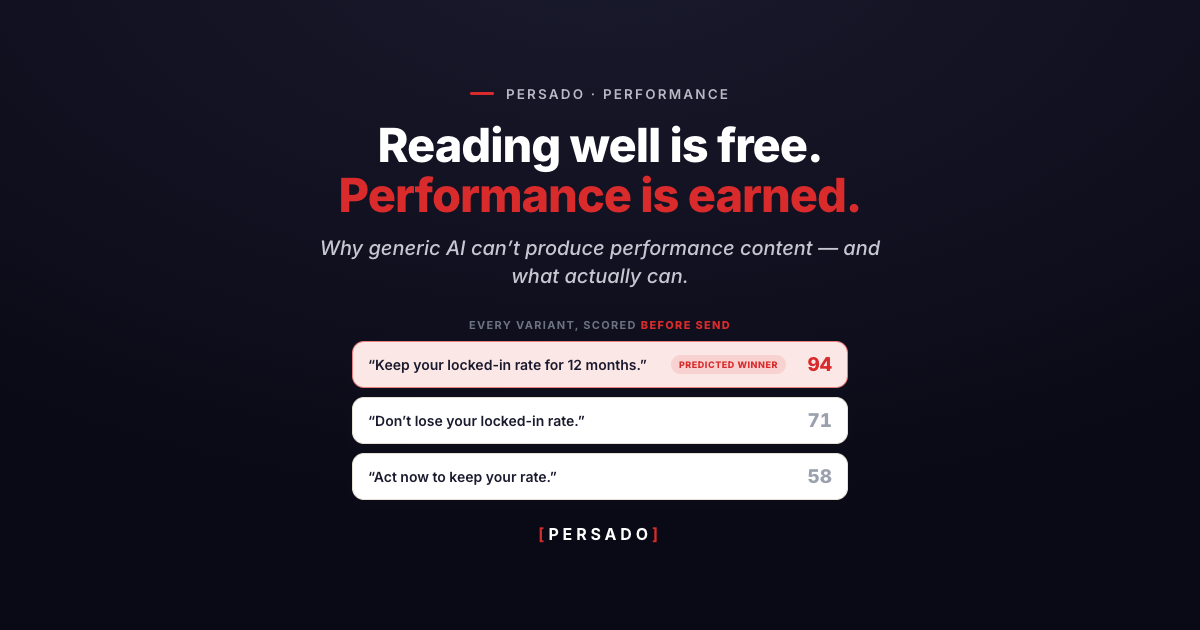
- It's predicted, not guessed. Each variant carries an explainable score for how likely it is to perform before it's sent — so choosing what to ship is a decision, not a coin flip you settle with an A/B test after the money's already spent.
- It's learned from outcomes. The system producing it has seen which messages actually won, at scale, and encodes that — so "performance" rests on evidence, not on the model's sense of what a good sentence looks like.
Everything else is content that might perform. Performance content is content you have reason to believe will.
Why generic AI can't produce performance content
A general-purpose language model is trained to predict the next plausible word across the open web. That makes it fluent. It does not make it effective. Three gaps matter:
- It optimizes for plausible, not for performance. The model has no idea which subject line lifted approvals for a card portfolio last quarter — it was never trained on that outcome. It returns the most likely sentence, which is not the same as the highest-performing one.
- It has no memory of what converted. Every prompt starts from zero. A rented model can't tell you why one appeal beat another with your audience, because it never saw the result. Generic AI produces a draft; it can't produce a prediction.
- The "score" is a black box — when it exists at all. Bolt-on tools that rank copy usually can't explain why. For a regulated brand, an unexplainable score is unusable: you can't put "the model liked it" in front of a compliance reviewer.
This is the trap in "AI content." The output reads well, so it feels like performance. But reading well is table stakes now — every tool clears it for twenty dollars a month. Performance is the part they can't fake, because performance is earned from data they don't have.
Performance is earned from outcomes, not summoned from a prompt
You can't prompt your way to performance. The edge is a body of evidence about what actually moves your audience — and that has to be accumulated, not generated.
Persado's Performance Prediction Score is built on 1T+ messages analyzed across 120K+ performance-labeled campaigns, refined over 10+ years in financial services. That's the difference between a model that writes a plausible sentence and a system that can rank variants by how likely each is to win — and explain the reasoning in terms a marketer and a compliance officer can both follow. The score isn't a black box.
And it compounds. Each asset makes the next one smarter — every campaign feeds labeled outcomes back into the model, so the prediction sharpens over time. That's why performance content behaves like a performance intelligence layer, not a one-time analysis: the value is cumulative. Across that history, the measured result is a 96% win rate against human-written and generic-LLM content, across 120K+ campaigns, and $2.5B+ in incremental value — measured against control, across all communications, over four years.
For regulated brands, performance without compliance isn't performance
Here's the part most "performance content" conversations skip. In financial services, a high-performing message you can't get approved is worth exactly nothing. The variant that lifts conversion but trips a disclosure rule never ships. So performance and compliance aren't two goals to balance — they're one requirement.
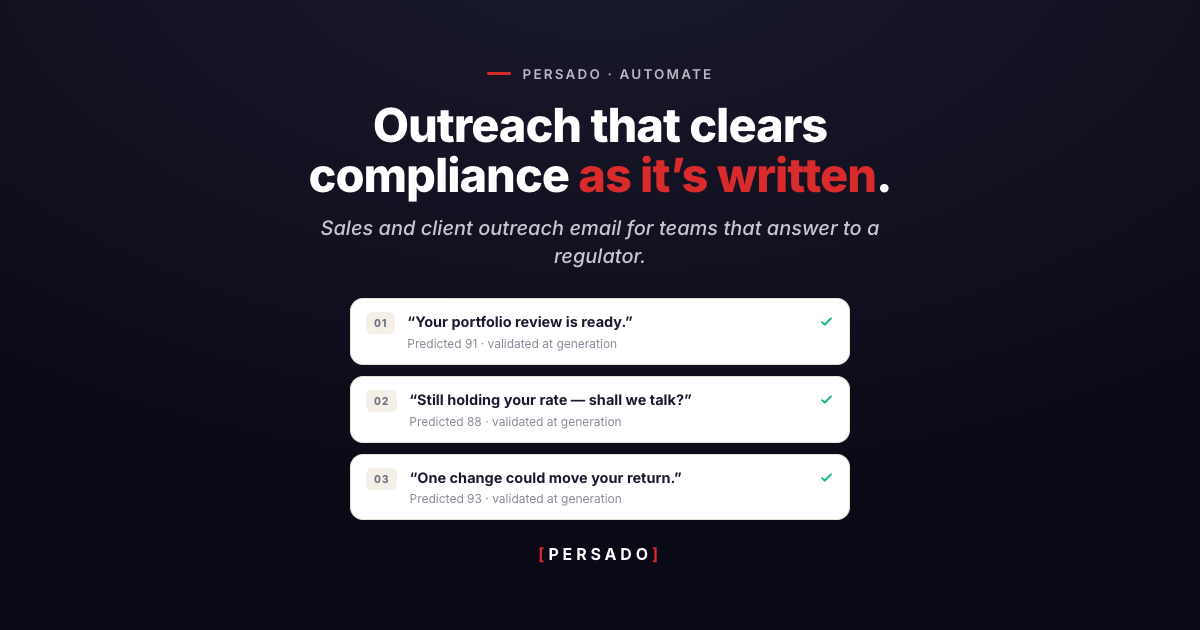
That's why performance content for regulated industries has to be generated with compliance validated during generation, not bolted on after review. Every variant is checked against your regulatory frameworks as it's produced, so the highest-performing option that reaches a human is already inside the guardrails. Performance you can actually deploy is the only kind that counts — and deployability is a compliance property, not just a creative one.
How to tell performance content from content that just reads well
If you're evaluating any tool that promises "high-performing" copy, score it against four questions:
- Can it predict which variant will win before I send — with an explainable score? — Without prediction, "more content" is just more guessing. Without explainability, the score is unusable in a regulated review.
- Is the model trained on outcome data, or on the open web? — A model that never saw what converted can write fluent copy; it can't rank for performance.
- Does performance compound — does each campaign make the next prediction better? — A one-time analysis decays. A performance intelligence layer sharpens.
- Is the highest-performing variant also deployable — compliant as generated? — In regulated industries, a variant that can't clear review has zero performance value.
Most tools clear the first column with a marketing claim and fail it in practice. That gap — between content that reads well and content engineered to perform, predictably and compliantly — is the whole point.
Frequently asked questions
What is performance content?
Marketing content created and selected to maximize a measurable outcome — opens, clicks, conversions, approvals — with each variant scored for likely performance before it ships, rather than written simply to read well.
How is performance content different from AI-generated content?
Most AI-generated content is optimized to be plausible — the most likely next sentence. Performance content is optimized to be effective, using a model trained on real campaign outcomes, and it comes with an explainable prediction of how it will perform.
Can you predict content performance before launch?
Yes — with a model trained on enough labeled outcomes. Persado's Performance Prediction Score ranks each variant by likely performance before send, built on 1T+ messages across 120K+ campaigns, and explains the reasoning instead of returning a black-box number.
Is predictive content the same thing?
"Predictive content" usually refers to the prediction step specifically — scoring or forecasting a variant's performance. Performance content is the broader idea: content generated and selected to perform, with prediction as one part of it.
The bottom line
The question was never whether AI can write your marketing. It obviously can. It's whether the content was built to perform — predicted before it ships, learned from real outcomes, and compliant enough to actually deploy. Reading well is free now. Performance is earned.
Persado is the regulated-ready creative system that turns a decade of financial-services outcome data into content you can send with confidence — performance-scored, and compliant as generated.
![[PRODUCT UPDATE] Three new ways to use Persado](https://a.storyblok.com/f/291846000560732/ec5ff57a41/q3-rundown-cover-v2.png)