The Great AI Distraction
Walk into any financial services marketing boardroom today and you will hear the new buzzwords: Answer Engine Optimization (AEO) and Generative Engine Optimization (GEO). Executives are scrambling to restructure their online presence so their brands are cited by AI engines — redesigning pages, auditing crawl paths, mapping schemas with a singular, anxious obsession: how do we make the machines happy?
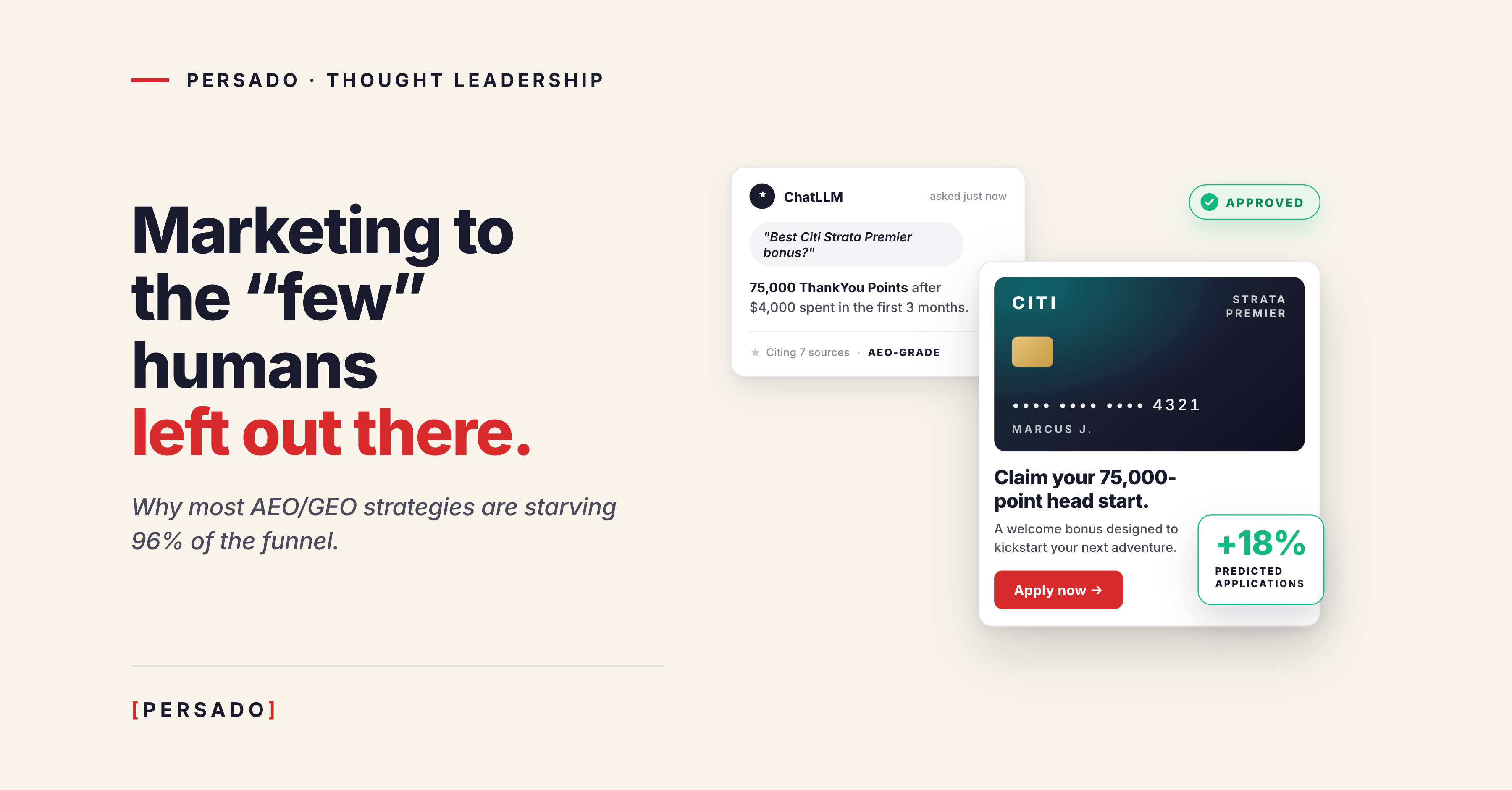
But in the rush to optimize for algorithms, marketers are obsessing over the bots while neglecting the human. Strip out emotional resonance and narrative depth to satisfy a crawler, and you create a sterile experience that misses the human “why.” You might win the AI citation. You will lose the human conversion.
The Discoverability Blueprint
Marketers organizing for AI-mediated search are converging on four areas: intent alignment, retrieval structure, GEO guidance, and performance audit.
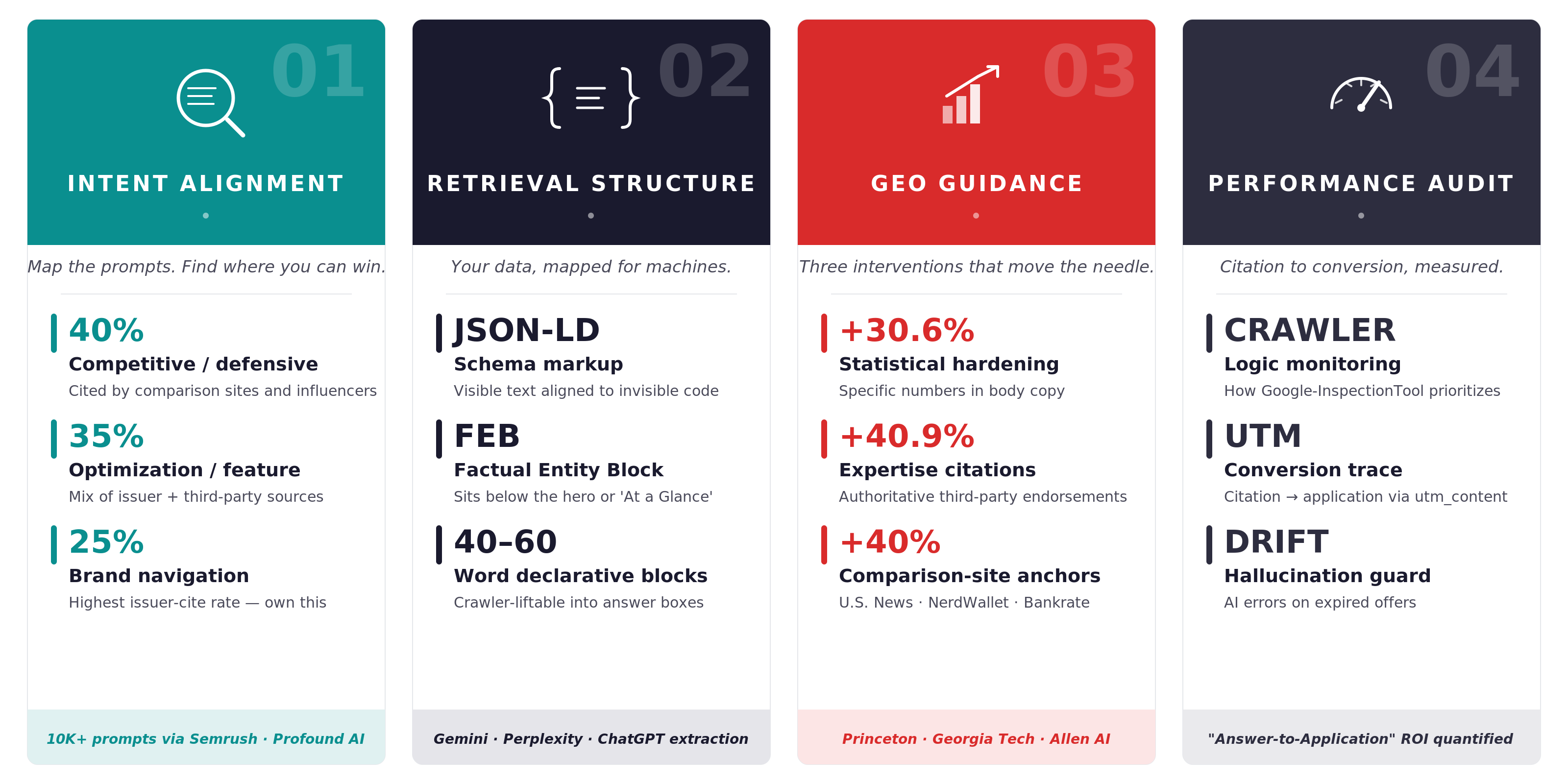 Figure 1 — The Discoverability Blueprint. Four areas, with the Princeton/GEO intervention figures and a worked Factual Entity Block example for a premium co-brand travel card.
To support, manage and govern these activities, a brand-new martech stack has emerged. Leading platforms providing advanced discoverability capabilities—such as Profound AI, Limy.ai, and the Adobe LLM Optimizer—allow companies to systematically fire thousands of automated prompts to track Share of Voice (SOMV), citation density, and model drift as well as understand which part of the site are crawled and how to close the loop between answer engines and results.
All four pillars are eventually important to tackle but marketers should focus first on quick wins:
The retrieval structure - Clean HTML architecture for rapid retrieval of metrics (Fees/APRs/Miles) without extraction gaps. This serves as the "Source of Truth" for AI scrapers comparing cards.
Leverage the most cited Independent research from Princeton, Georgia Tech, and Allen AI that documented three interventions that move the needle:
a. a +30.6% visibility lift from “statistical hardening” (specific numbers in body copy),
b. a +40.9% lift from expertise citations on your brand website
c. a +40% lift from anchoring to comparison-site references. [1]
The Reality of the Funnel: Cold Hard Small Numbers
LLMs don’t buy financial products. Humans do.
According to Mintel (highly recommended for any financial services exec wanting to know what the market is doing) Q1 2026, just 3.8% of credit card acquisitions are driven directly by AI answer engines. And though it doubled from the previous quarter, still over 96% remain unmediated by AI. And 100% of final purchase decisions are still made by human beings. [2]
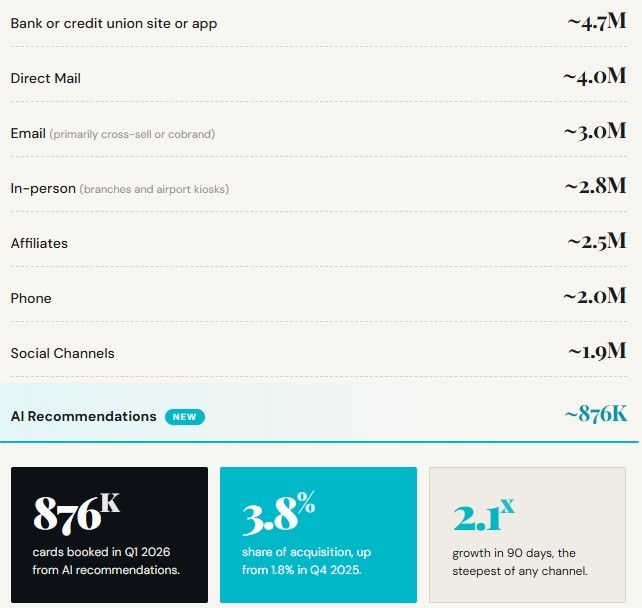
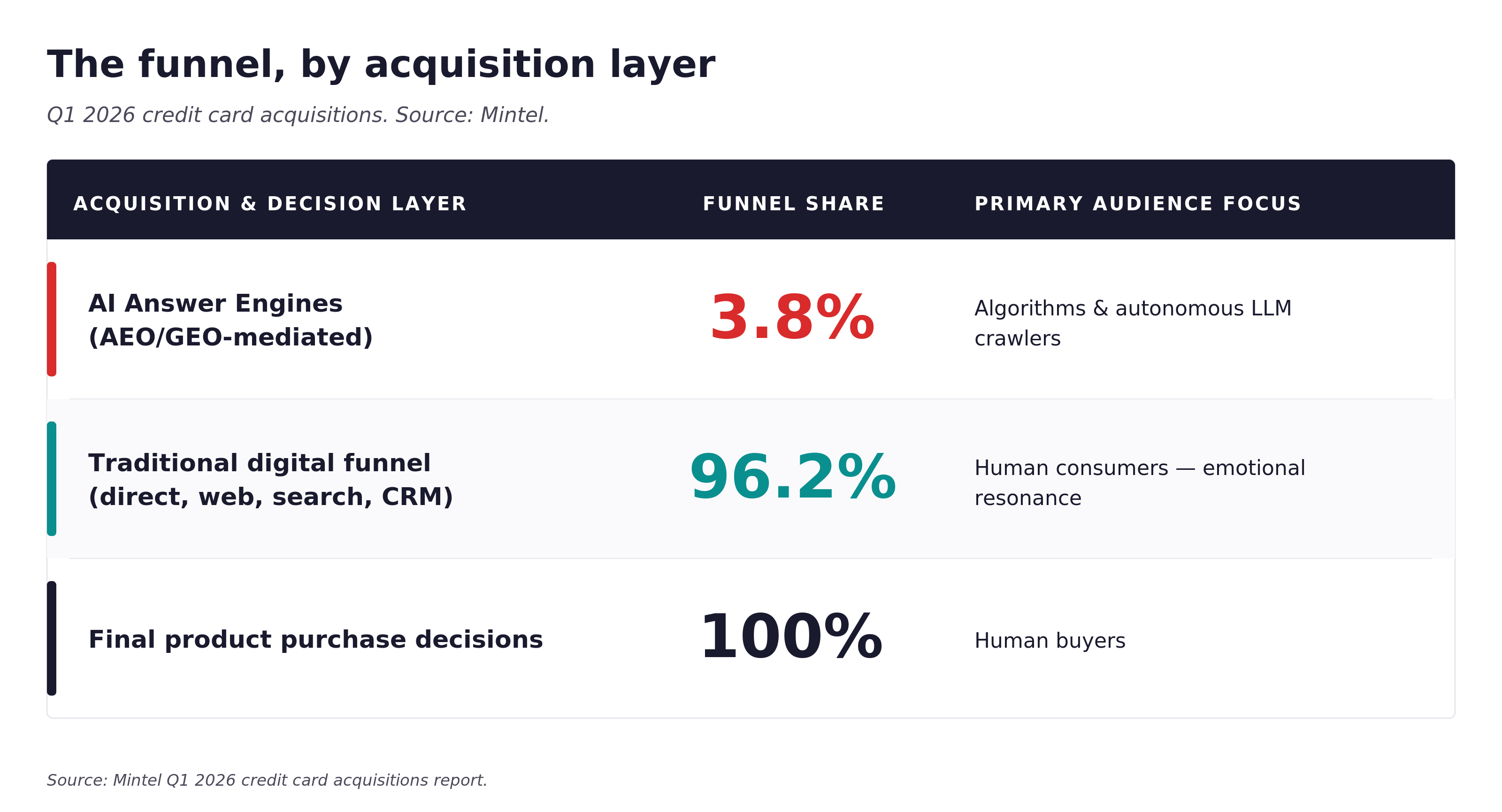
Why Mintel shows share for Credit Card acquisitions here’s a broader view from Conductor (Conductor.com) showing the share of traffic across 10 industries coming from AI vs other channels. AI referral traffic currently represents just over 1% of total web visits and is growing by roughly 1% each month, on average while for financial services it’sat 0.48%.
While AEO is becoming a specific performance channel to drive a brands credibility it should not be driving a shift of the entire online content strategy of a brand.
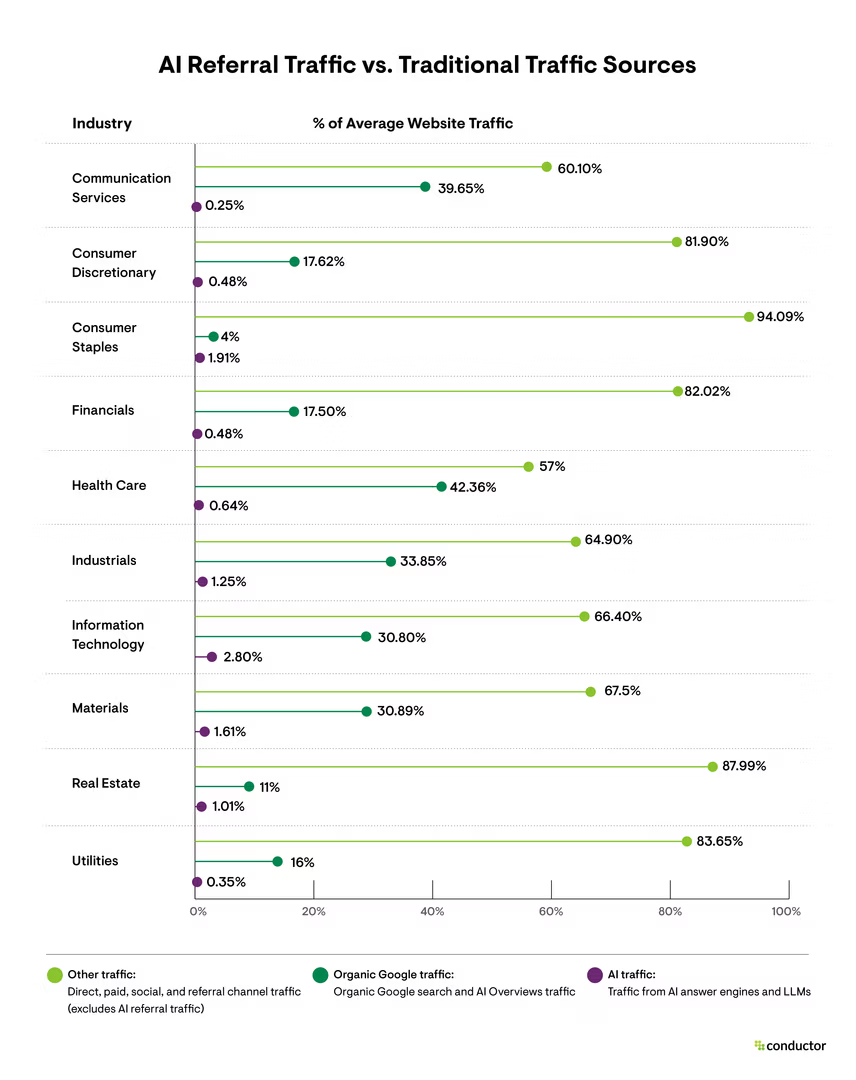 Last updated:Apr 14, 2026
https://www.conductor.com/academy/aeo-geo-benchmarks-report/
Some may argue that if you are not “discovered” there won’t be a human to make a decision. And while banks and fintechs need to be part of that transformation they cannot sacrifice 95%+ of decisions that will remain human.
The Reality of My Impact as a Marketer
Not only is the AI share is currently small, but the marketer’s influence is narrower than you think. 40% of consumer prompts are competitive/defensive — “is the Strata better than Chase Sapphire Preferred for family rewards?” Almost all citations for those queries come from comparison sites and influencers, not from the issuer. The one category where the brand ranks #1 is brand navigation and accuracy — “can I redeem my card points with partner A or B?”
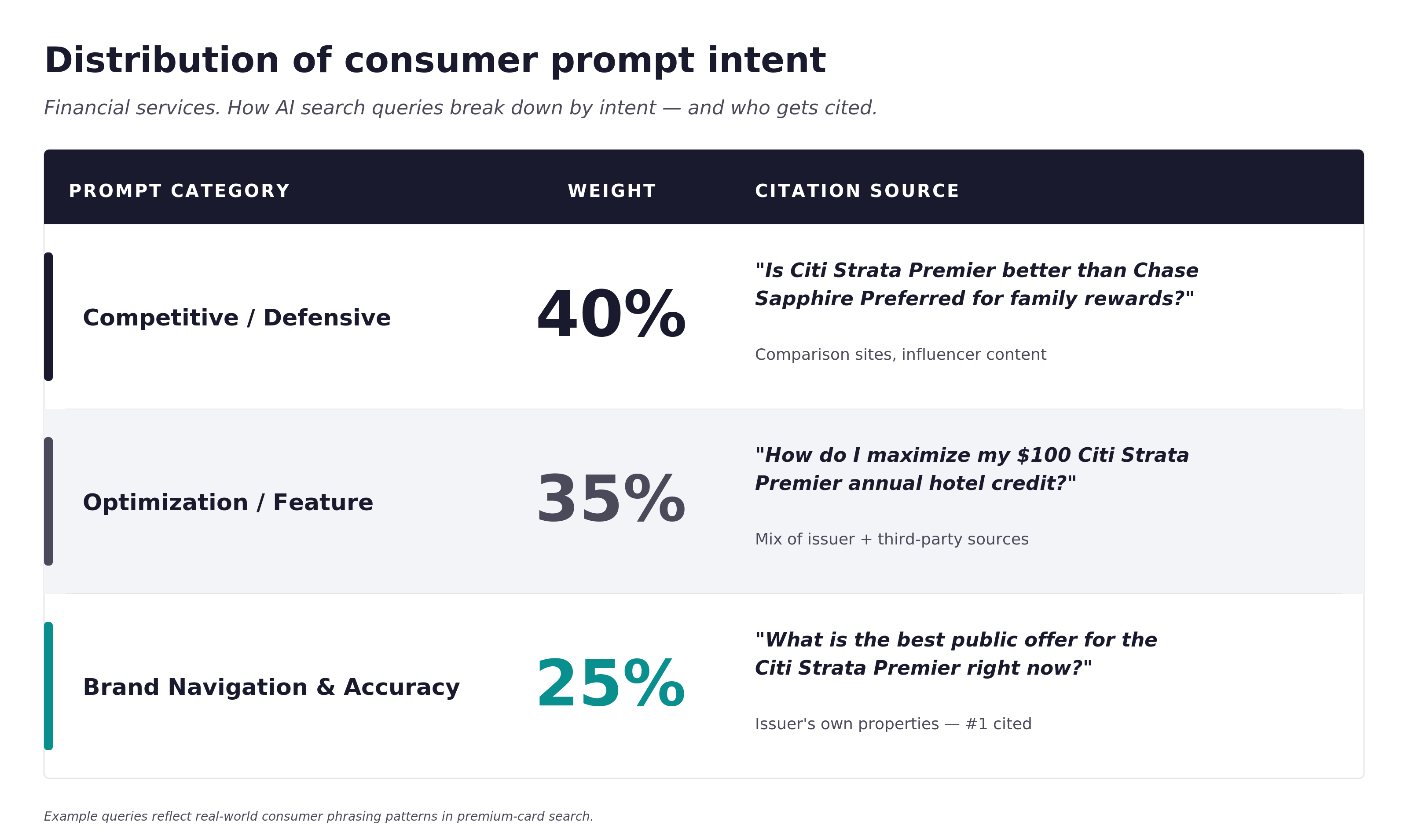 Figure 3 — Distribution of consumer prompt intent in financial services. Brand navigation is the one category where the issuer is the #1 cited source.
That 25% slice is where you can win. Own it with clean HTML architecture, Factual Entity Blocks below the hero, and favorable third-party expert opinions woven into your .com.
The Typeface of a Disclosure Table
Machines and humans are motivated by entirely different inputs. To satisfy an LLM crawler, your digital architecture demands JSON-LD schema, Factual Entity Blocks, and non-adjectival grounding text — short, declarative 40-to-60-word summaries OpenAI, Gemini or Perplexity can lift into an answer box.
But let’s be honest: no human being has ever signed up for a premium co-brand credit card because they fell in love with the typeface of an HTML disclosure table. Humans buy on emotional drivers — the status of walking into an exclusive airport lounge, the family vacation they didn’t think they could afford. Achievement. Status. Convenience. Aspiration.
The “AI/Human” Paradigm: Marketing to Both
We do not have to choose. Brands that win the entire customer journey adopt a dual approach to content — layering the machine’s structural data needs inside the human’s emotional narrative:
The AI — statistically hardened facts, clean HTML tables, rigorous JSON-LD metadata that ensure AI engines identify your brand as a source of truth.
The Human — Emotional and narrative depth that resonate with the user, bypass skepticism, and drive the business.
A 25-to-34-year-old searches “is this card worth the annual fee if I travel 4 times a year?” Two things happen at once. An LLM composes an answer and the issuer needs to be cited in. The user then lands on a page that has to make them feel something. The first audience grades on accuracy. The second grades on emotion and narrative. Both relate to the same proposition. Neither lands alone.
What this really requires is a system that can serve both audiences at once — generating on-brand, performing, compliant content with certainty across the AEO substance and the human-emotional layer, in a single approval cycle. Here’s how that looks at Persado, applied to one prospect across five consumer queries.
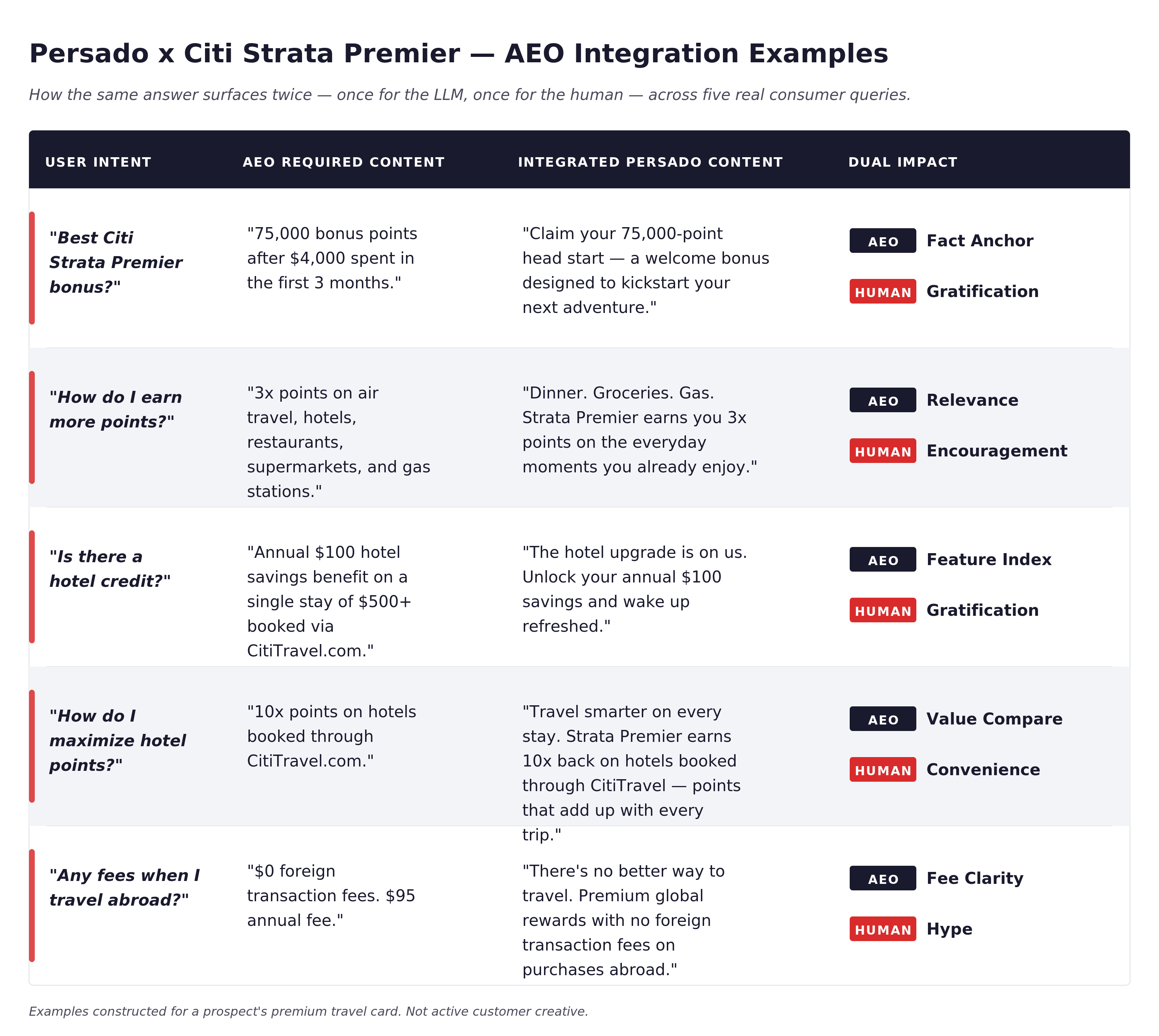 This is the architecture we’ve spent the past decade building at Persado: generative AI that scores for performance and compliance at the moment of creation, while preserving the brand voice that humans actually respond to. The Core and the Shell, produced together, in a single approval cycle.
Stop Starving the Human Funnel
The rush toward AI discoverability is a valid evolution. Treating it as a zero-sum game that ignores human decision making processes is a recipe for crashing conversion rates.
True innovation isn’t shifting focus to LLMs instead of humans. It’s mastering both. Feed the machine the precision it demands. Give the “few humans left out there” exactly what they need to feel and act.
Sources & Cited companies
[1] Aggarwal, P. et al. (Princeton / Georgia Tech / Allen AI), “GEO: Generative Engine Optimization.” arxiv.org/abs/2311.09735
[2] Conductor AEO/GEO Benchmarks Report, last updated April 14, 2026. conductor.com/academy/aeo-geo-benchmarks-report/
[3] Mintel Q1 2026 credit card acquisitions report. [Internal: link to be added before publish.]
Companies mentioned: