Picture two sprinters in the 100 meters. One finishes in twelve seconds. The other finishes in ten. Watch them race and both look fast. If you had spent your life standing still, either one would look superhuman.
But twelve seconds and ten seconds are not two versions of the same thing. Twelve is a fit amateur. Ten is an Olympic finalist. There is no race where those two meet, no event where the amateur’s twelve comes close. And the gap was not settled on race day. It was built years earlier, in training that happened long before either runner reached the line.
That is what I keep coming back to when a marketing leader asks me whether generic AI is good enough for their content.
Everyone can run now
Let me give the generic models their due. They are remarkable. They produce fluent, on-brief copy in seconds. For a small brand starting from a blank page with a stretched team, a general-purpose tool is a real upgrade. It is the difference between not running and running.
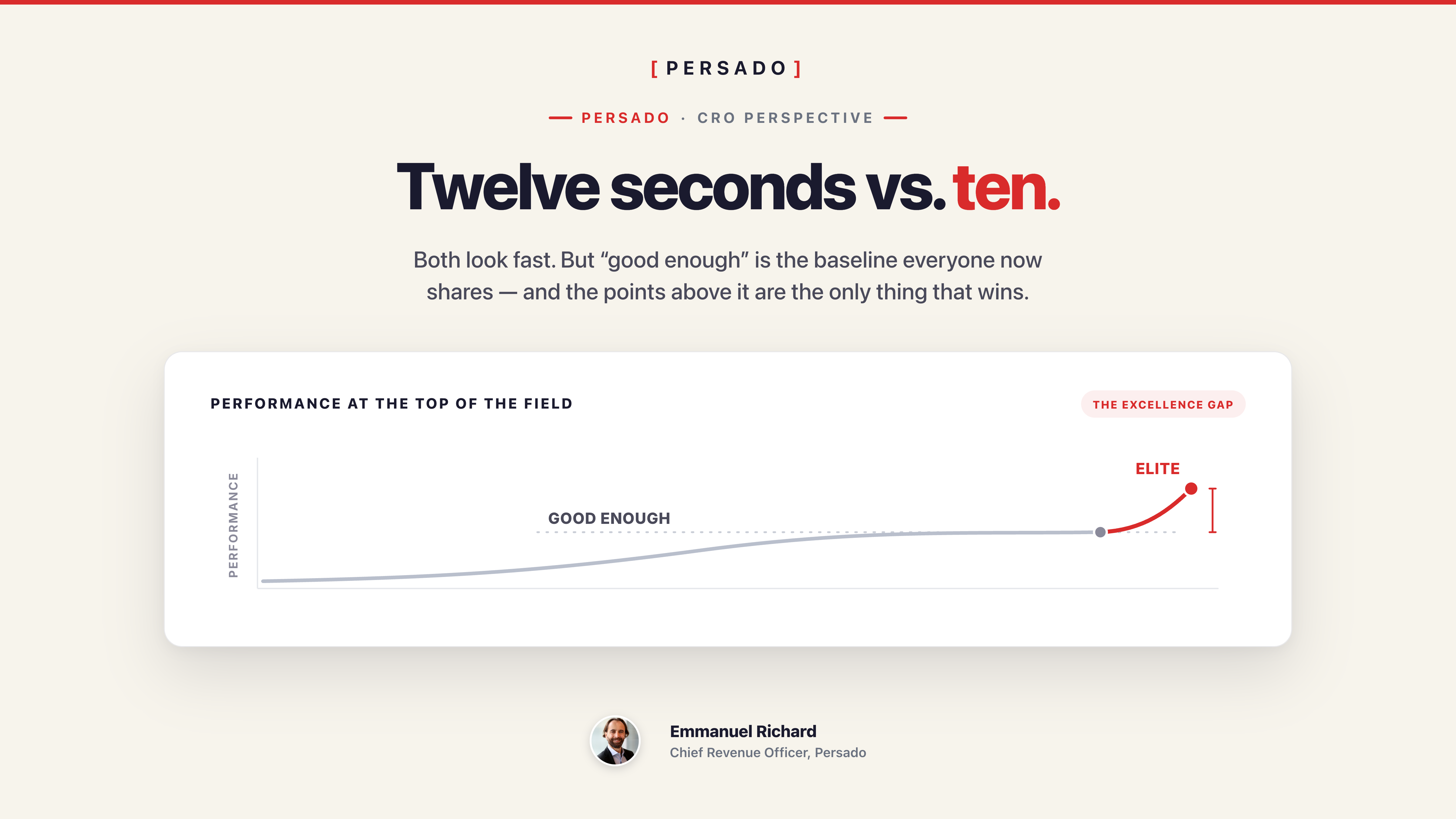
But running is now table stakes. Every brand has the same models. Every competitor, every challenger, the same access. The blank page stopped being the problem. When a capability costs twenty dollars a month and millions of people have it, it cannot be the thing that sets you apart. It lifts everyone by the same amount and moves no one’s position in the race.
That is the twelve-second runner. Fast enough to feel impressive. Not fast enough to win anything that is actually contested.
The race the biggest brands are in
We recently sat with the marketing team of one of the most recognized consumer brands in the world. A household name, with decades of brand equity behind every word.
Their question was not whether AI could generate their copy. They knew it could. They had already produced a thousand passable variants by lunch. Their real question was harder: at our scale, will any of this actually move the numbers?
For a brand that size, a one or two point lift is not a rounding error. It is eight or nine figures. The marginal gain at the very top of the curve, the two seconds between ten and twelve, is the whole game. And a tool everyone else also has cannot hand you a gain that everyone else does not also get.
That is the trap of good enough AI for the world’s largest brands. It speeds up the part that was never the bottleneck and leaves the part that decides the outcome untouched. It is a faster route to the same ceiling everyone else is hitting.
You cannot prompt your way to elite
Here is what the ten-second sprinter has that the twelve-second sprinter cannot copy. It is not effort on the day. Not a better warm-up, not a smarter instruction shouted from the sideline. It is training. Years of it. Specialized, deliberate, measured, building something into the athlete that cannot be summoned on demand.
AI that performs works the same way.
A general model is trained on the open internet, which means it is trained on everything and therefore on nothing in particular. It has read the whole library and specialized in none of it. Prompt it well and you get a better draft. You cannot prompt it into expertise it was never trained to have.
What we built is different in kind, not degree. Persado’s models are trained on more than a decade of real performance outcomes in regulated, high-stakes marketing. Over 150 billion customer interactions. More than a million A/B tests. 120,000-plus performance-labeled campaigns. The system does not guess what language will work. It knows, because it has watched what actually moved real people to act, at scale, over years. That is not a prompt. That is training no general model has done and no competitor can buy off a shelf. Pair it with human experts who know these industries and you get the difference between a tool that writes and a tool that wins.
That is the moat. Not the architecture, because anyone can rent a model. The training is the thing.
In regulated markets, fast can mean disqualified
There is a second reason the twelve-second runner does not medal in the markets we serve. In a regulated industry, fast copy that is not compliant copy never reaches the track. It gets flagged, sent back, rewritten, reviewed again, and the speed you thought you bought disappears in the approval queue.
So we build compliance into the moment of creation, not after it. Content comes out compliant at the point it is generated. Performance and compliance produced together, not traded against each other. For a brand where one misstep becomes a headline, that is not a feature. It is the price of being allowed to run.
The question worth asking
When a marketing leader at a major brand asks me whether generic AI is good enough, I know what they are really asking. They want to know if fast and fine will protect a position that took decades to build.
It will not. Not because the generic tools are bad, they are genuinely good, but because good is now the baseline everyone shares. The entire point of a flagship brand is to not sit at the baseline.
So the right question is not whether the AI can write copy. Everyone’s can. The question is whether it was trained to win. At the top of the field, where you operate, those two seconds are the only thing that has ever mattered.
![[PRODUCT UPDATE] Three new ways to use Persado](https://a.storyblok.com/f/291846000560732/ec5ff57a41/q3-rundown-cover-v2.png)